There are times when I travel and I find myself wondering how I got there and just how lucky I am to have had the opportunity. Earlier this month was one of those occasions. A week’s travel in Bangladesh was divided in two parts; the first comprising a couple of days in Kushtia and the second some time in Rajshahi.
Both lie in the north west of the country, and my motivation for visiting each was formed from two aspirations. I’ll begin with Kushtia, where each year two festivals take place. The first in March and the second in October, respectfully marking the birth and death of a prominent Bengali figure – Lalon.
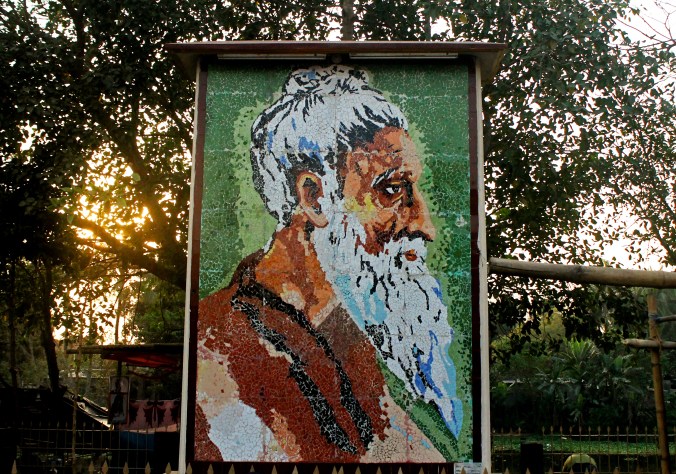
I won’t delve into a deep explanation as to who exactly Lalon was as I certainly cannot claim to possess the necessary knowledge. To summarize, however, he was predominantly known for being a philosopher, a mystic, a songwriter and a free and open thinker who inspired many to follow his teachings and wisdom. As such, each year these followers congregate at his shrine in Cheuriya, Kushtia to pay homage and celebrate his life and mark his death.
Here is a link for more information and explanation on Lalon’s life and philosophy –
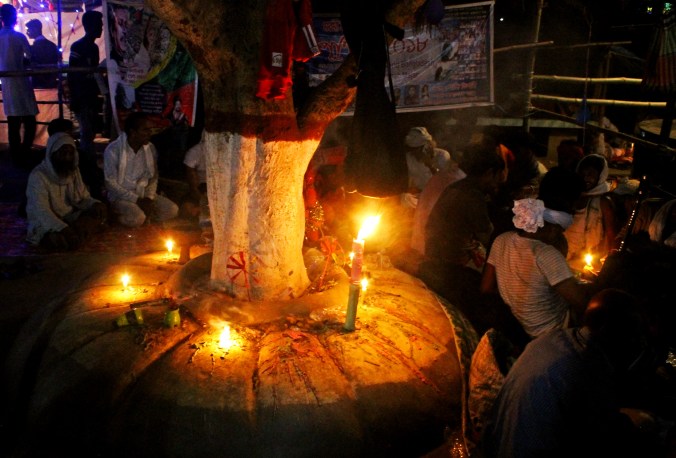
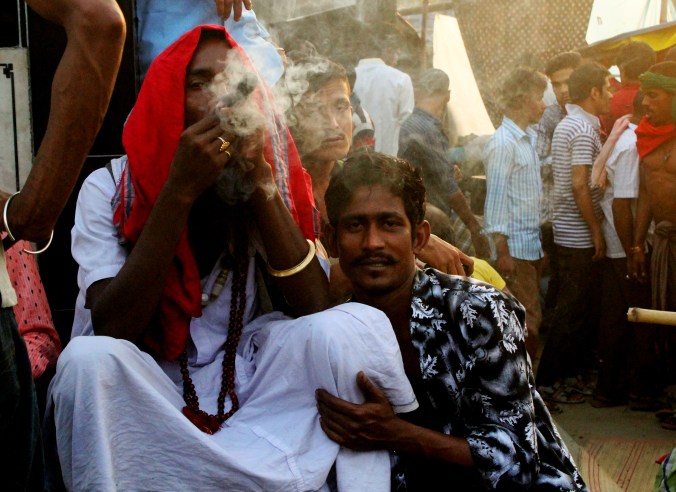
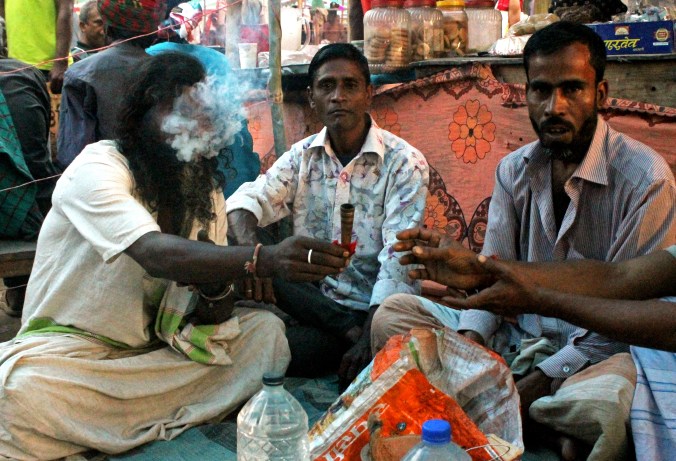
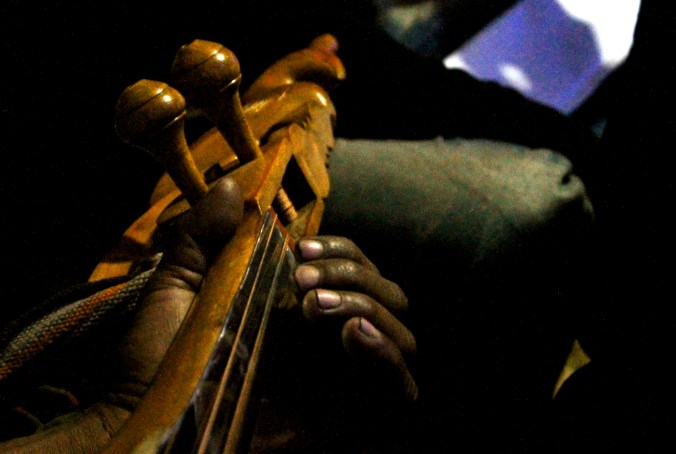
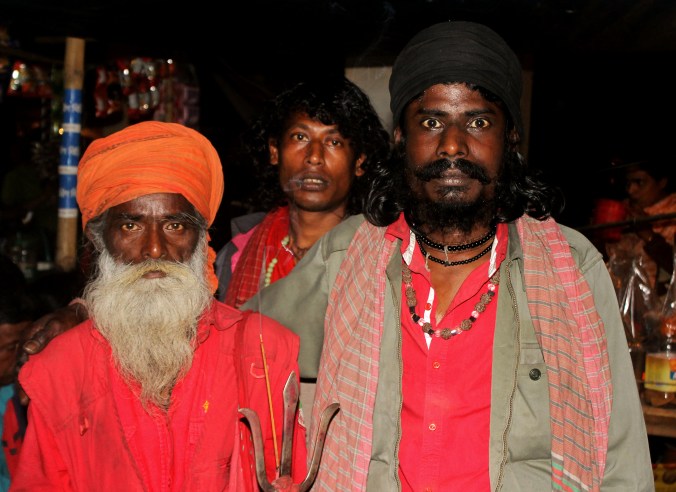
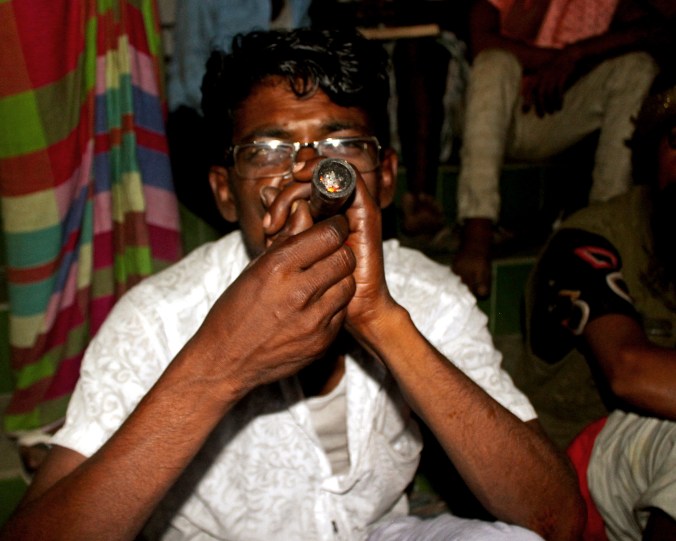
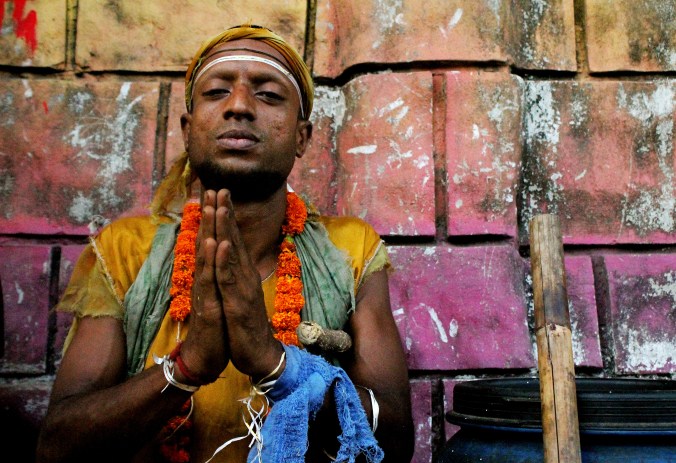
These festivals (known as ‘Lalon Smaran Utshab’ – Lalon Memorial Festival) take place over three days and see people come from all over Bangladesh and West Bengal to connect in song, dance and poetry. Devotees and followers visit Lalon’s shrine and many spend their days and nights enjoying the music, meditating, smoking marijuana and sleeping under the stars.
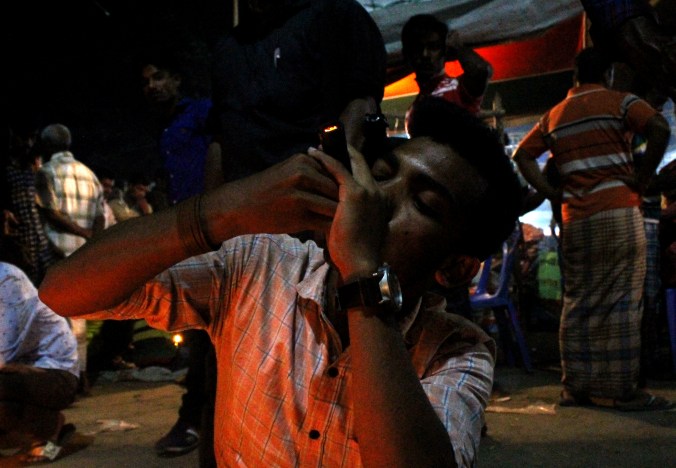
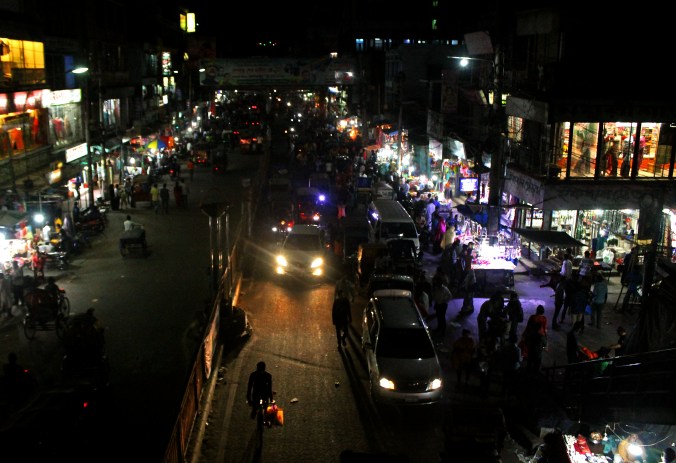
I was lucky enough to attend this year’s festival. It was a fascinating event and one that I certainly won’t forget. The crowds were dense and disorientating, and the time spent there was a unique sensory experience on so many levels. The sounds, the energy, the aroma of the vast varieties of food, and the hospitality from a wide cross-section of people all contributed to an experience that left me exhausted, yet invigorated.
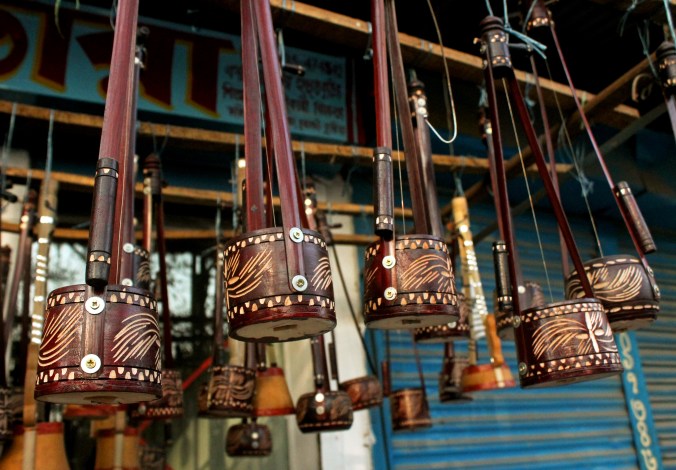
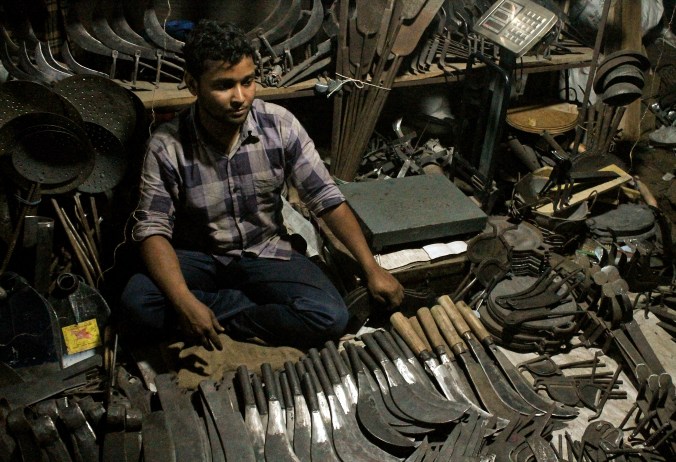
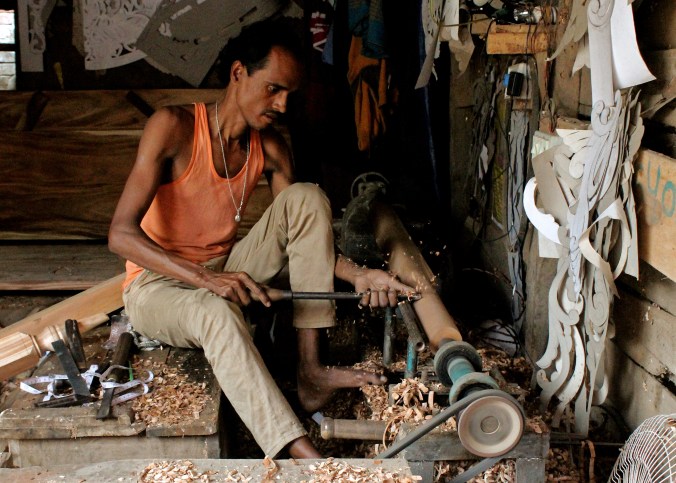
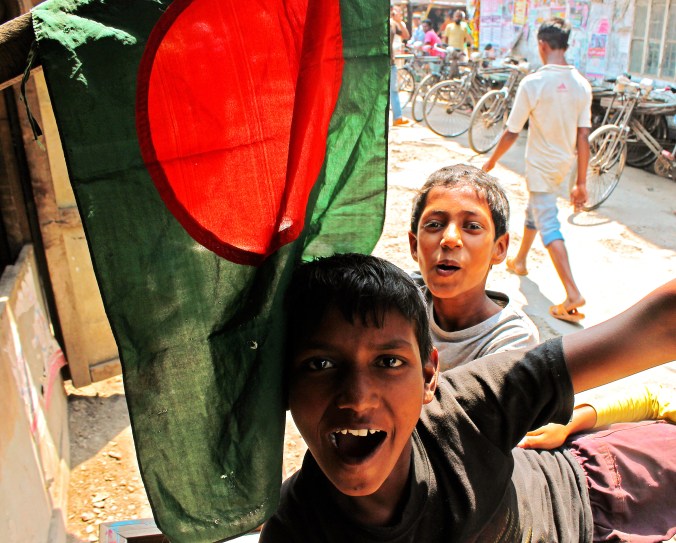
Here is a selection of photos from those two days, which hopefully capture some of the essence of the festival. Part of the festival comprises a ‘Mela,’ which basically means fair and therefore you find a vast array of stalls selling food, clothes, wooden carvings, toys, jewellery, etc, etc.
Rajshahi
The second part of my trip took me just north of Kushtia and to the city of Rajshahi. I had visited previously, but that was back in 2012, so I was eager to return as it’s a beautiful part of the country.
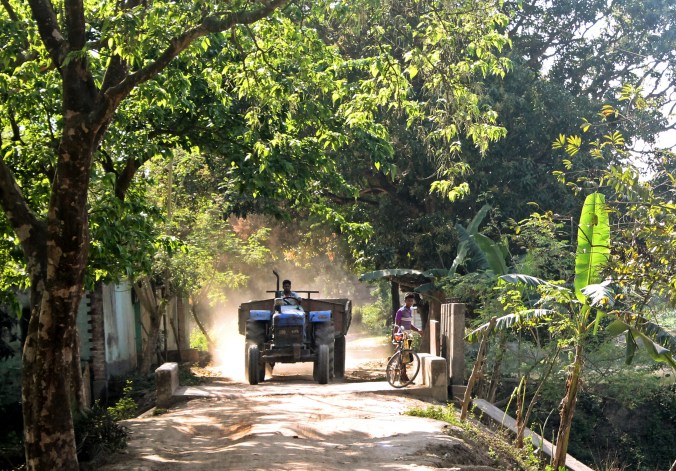
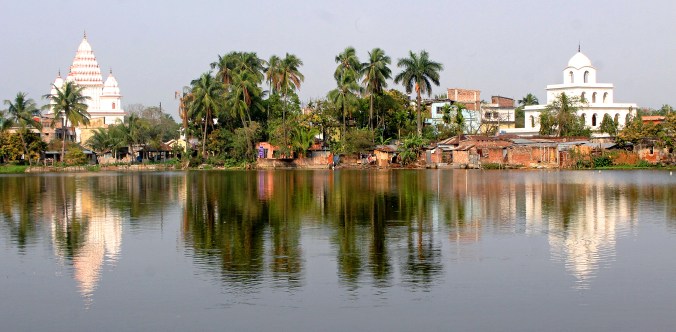
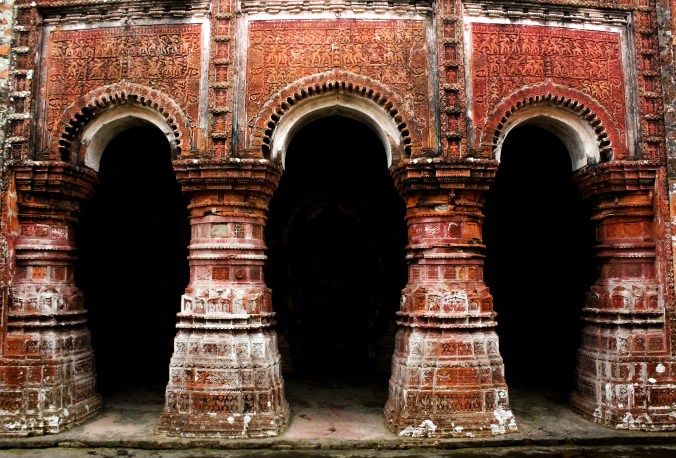
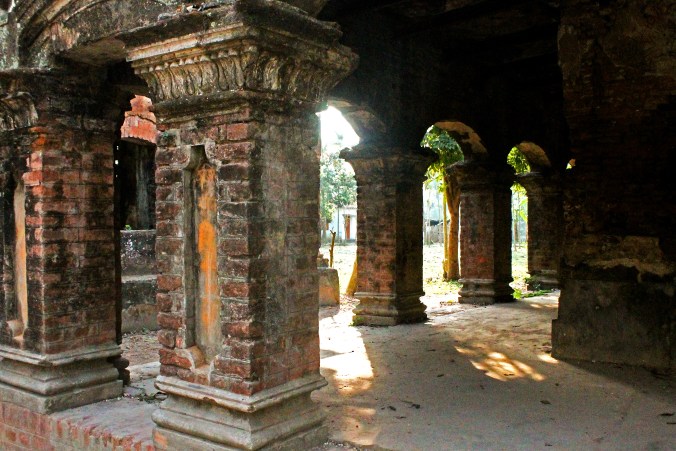
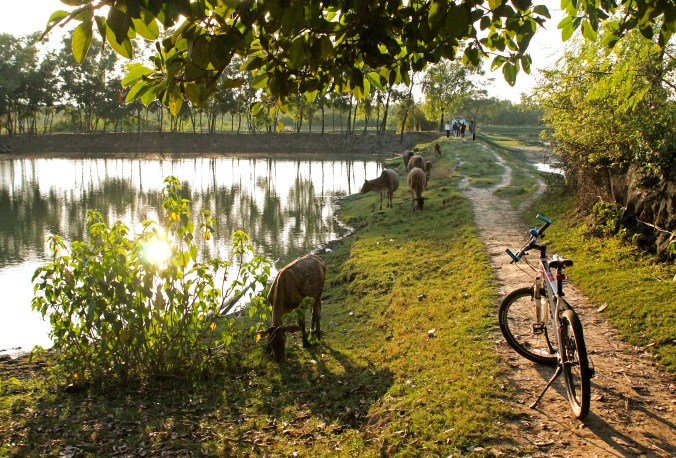
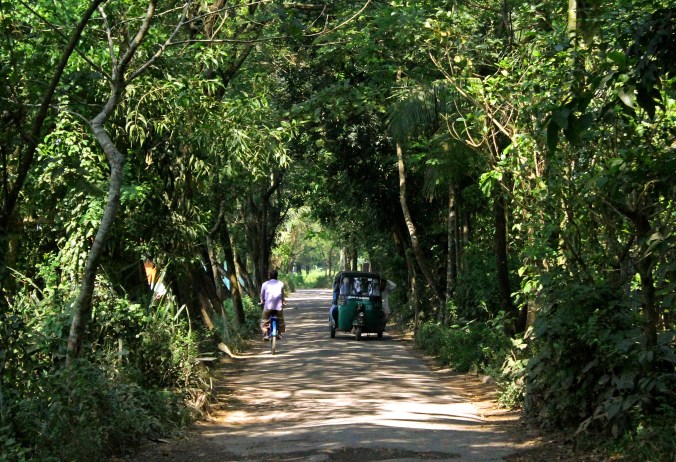
In contrast to the Lalon Festival, the time in Rajshahi was relaxed and a lot calmer! I explored the surrounding countryside and Puthia, a nearby town that is home to some intriguing old temples. Even within the city Rajshahi has a more laid back feel, and the wider roads remove the sometimes claustrophobic nature of Chittagong and Dhaka.
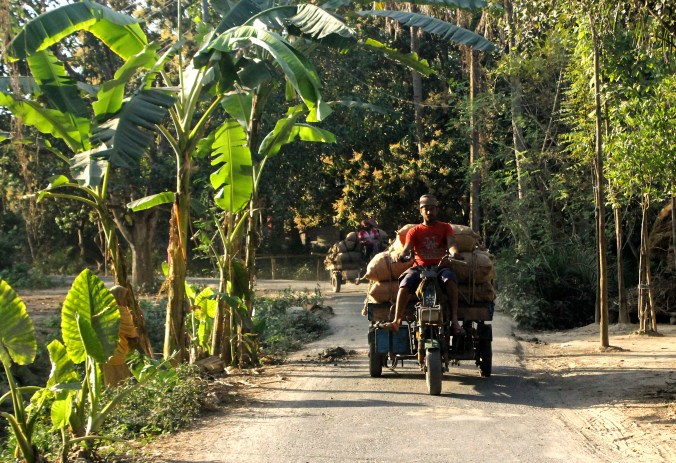
As always, it was full of the joys of tea, peaceful country roads, gorgeous countryside and a life very much in contrast to the frenetic and disorienting nature of the city. I hope you enjoy these images, of which there are many!
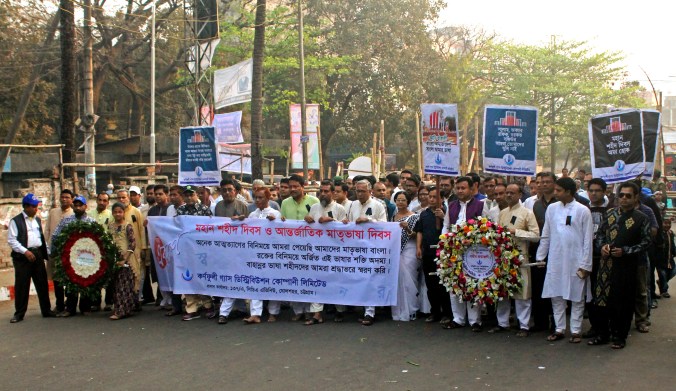
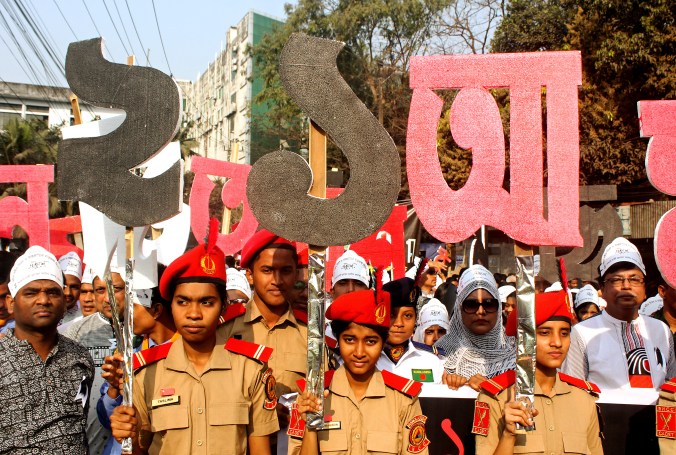
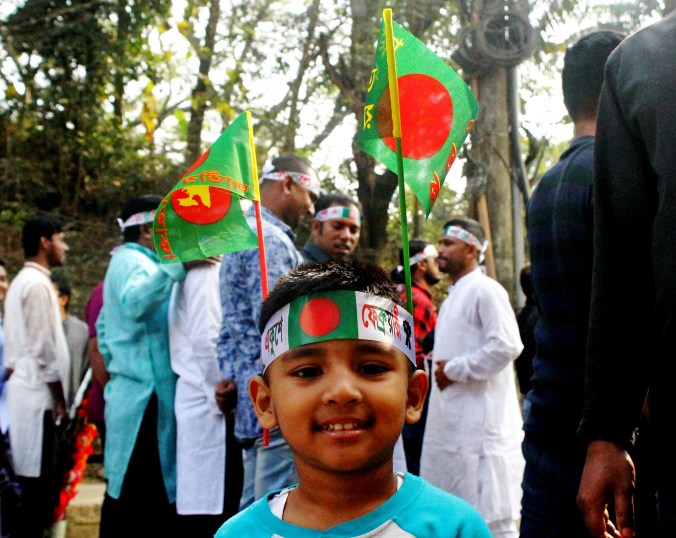
In 1999 UNESCO officially declared that International Mother Language Day will be marked on 21st February each year. I have to admit, prior to coming to Bangladesh I was totally unaware of this, but the origins of the annual observance lie very firmly and significantly in the history of this country.
For some, the day perhaps offers an opportunity to celebrate cultural expression, and acknowledge the work of notable writers, poets, playwrights, etc. However, for Bangladeshis this day respectfully marks a period of their history in which lives were sacrificed and foundations put in place for an ultimately successful, but severely painful independence movement.
The partition of India in 1947, resulted in the region of Bengal being split in two with West Bengal remaining part of India and East Bengal becoming a province in the newly created, Pakistan. Some years later East Bengal was renamed East Pakistan.
In 1948 however, the new government of Pakistan, whose administrative center lay in the Urdu speaking, western part of the country (almost 2,000 kilometers from Dhaka in the eastern part of the geographically divided state), declared Urdu the official language of the country to be used in schools and for all official purposes. Forty-four million Bengali speakers in East Bengal now faced the prospect of being denied their basic language rights with the outlawing of their mother tongue.
Prominent Bengali speakers attempted to negotiate this discriminatory language policy, but after four years, and with no sign of a compromise, students and political activists launched protests. This symbolized the beginning of the now famous language movement, and the first protest took place on February 21st, 1952, leading to the loss of life of several students.
Their legacy lives on though, as their actions became the catalyst for a continued, organised campaign, which forced the Pakistan government to relent on its refusal to recognize Bengali as an official language. Those who gave their lives for the cause are referred to as the language martyrs because of their sacrifice in the fight to preserve their mother tongue, and thus each year on 21st February Bangladesh commemorates their memory.
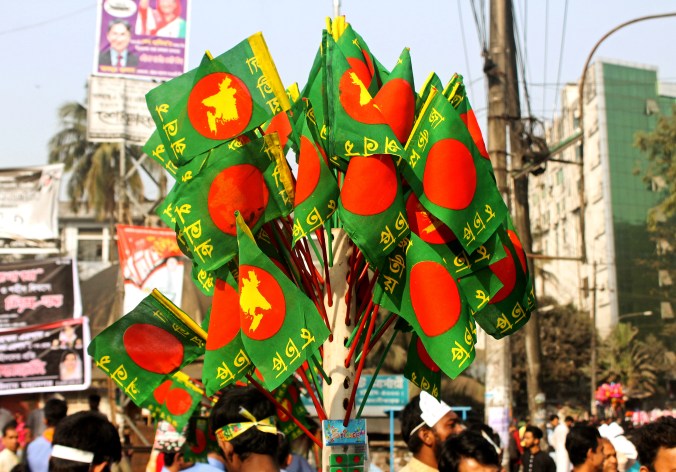
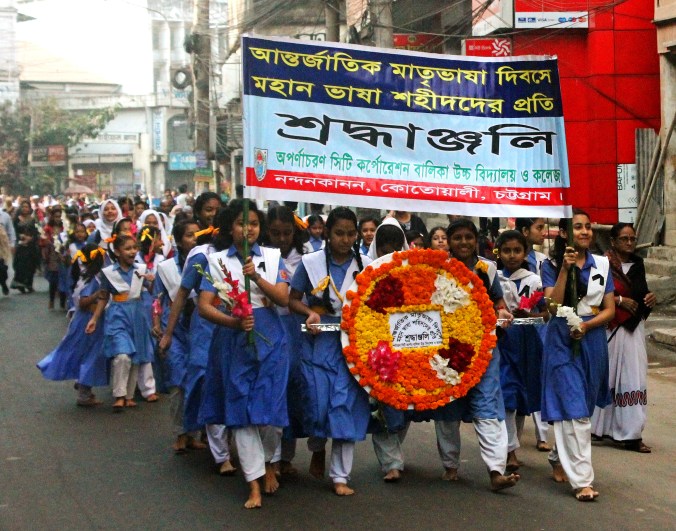
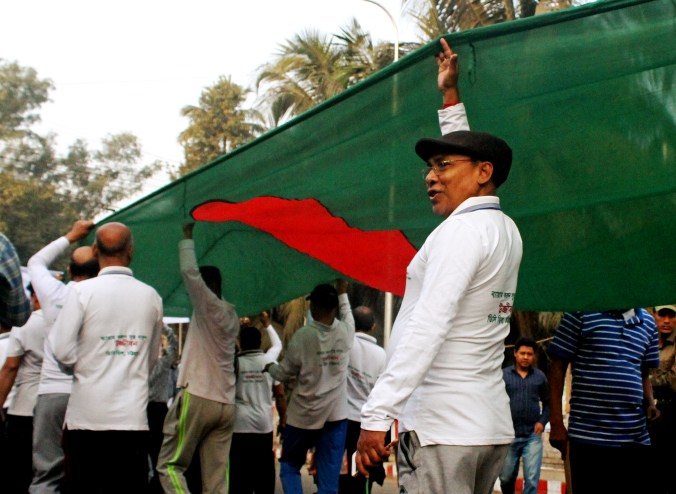
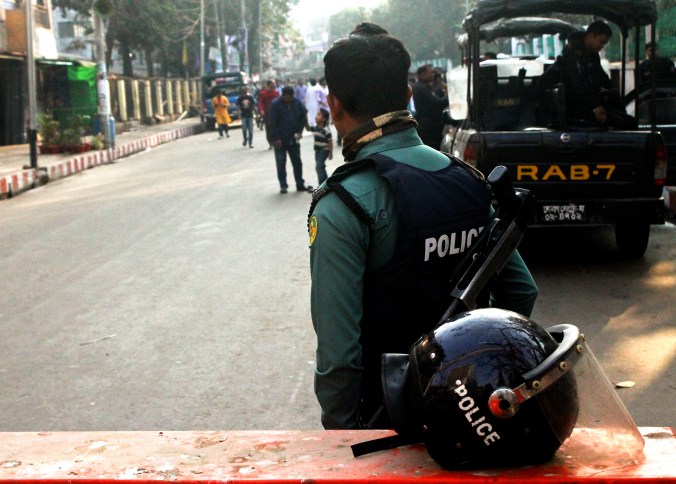
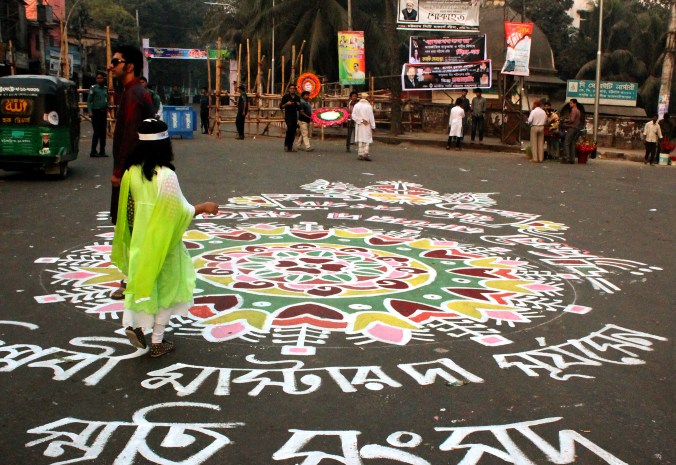
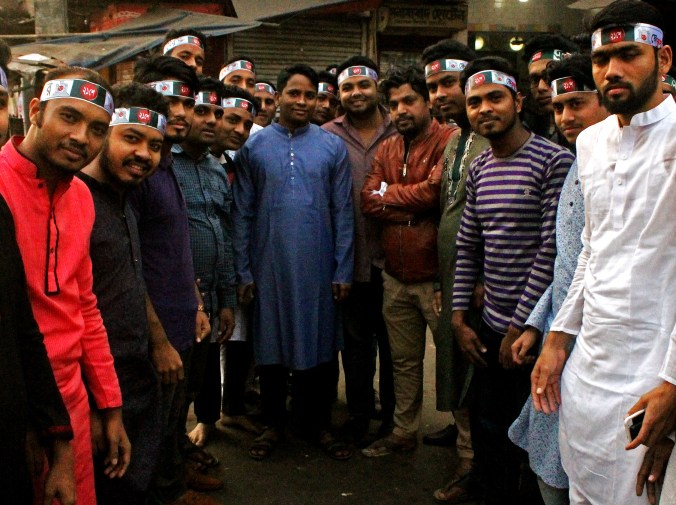
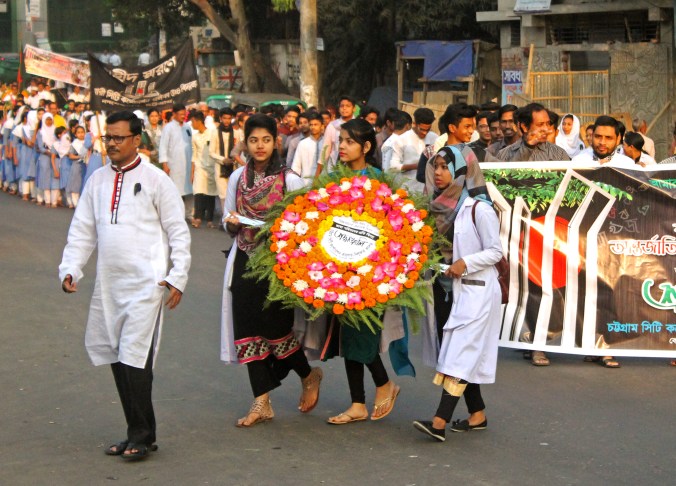
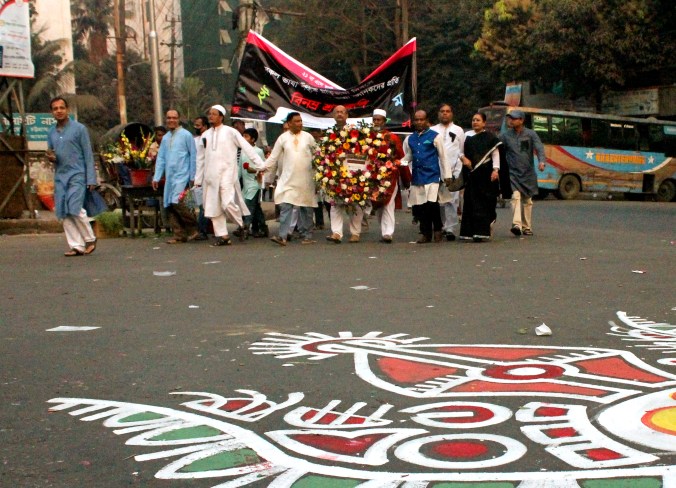
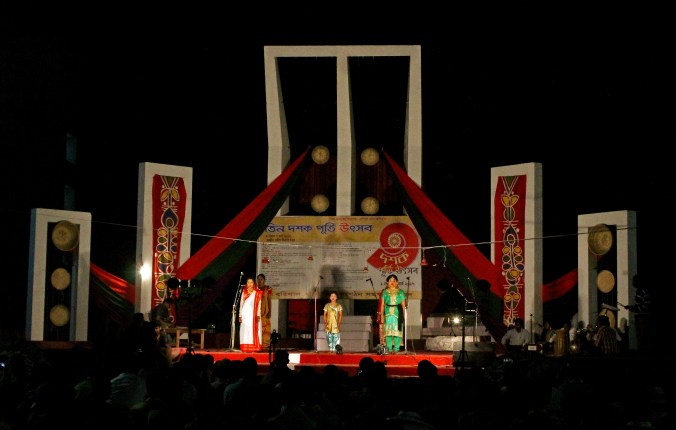
In a poignant show of respect and gratitude for the language martyrs, crowds of people, young and old, fill the streets and march in long lines towards the Shaheed Minars (‘Martyr Monuments’), on which they place flowers.
The language movement became all the more significant for Bangladeshis in the years proceeding 1952, as the population fought to achieve their independence from the West Pakistan government, which (aside from just language) had consistently denied the basic rights of its Bengali speaking people in the east. Having previously suffered years and years of violent and stifling oppression during British rule (prior to 1947), the people of East Bengal were understandably yearning for freedom and the realization of some of the most basic of human rights.
In 1971 the people of East Pakistan declared their autonomy from Pakistan and after a bloody and brutal war (known as the Liberation War), Bangladesh was born. The seeds of this independence movement were sown in 1952 however, with the language martyrs and their actions.
So that is a brief explanation as to why 21st February has been designated globally as International Mother Language Day. In a TED talk by Suzanne Talhouk, she raises the point that the ‘best’ way to kill a nation is to kill its language. The language martyrs knew this, so they were willing to lay down their lives in order to save their language, their culture, and their identity for generations to come. It is somewhat fitting then that their enduring sacrifice is not only marked within Bangladesh, but globally and on an annual basis.
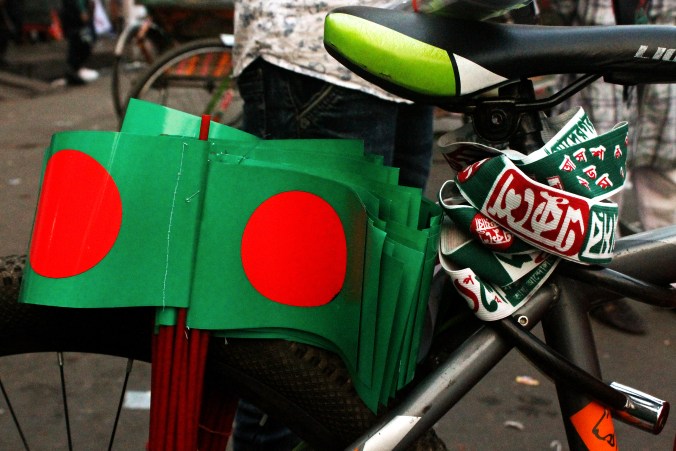
This year I visited the main Shaheed Minar here in Chittagong early in the morning and below are some of the images I captured.
It has been another long and inexcusable absence since I last updated this blog, but due to a welcome one week vacation, I finally found time to venture out with my camera and capture some new images that I feel inclined to share.
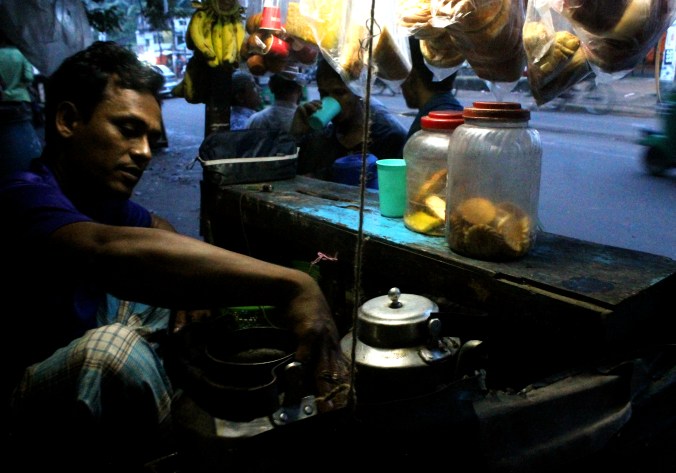
In a break from other vacations, I decided to remain here in Chittagong and utilize the time to further explore this city and its surrounding area. I did however stick to one vacation tradition and drink an excessive amount of tea! I also slept a lot. Suffice to say it was a pretty enjoyable week.
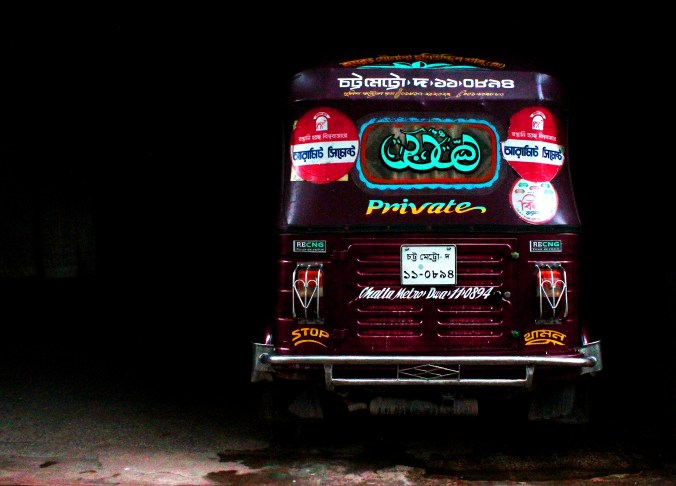
The title of this post (Chattogram) is the the name of this city in its local Chittagonian dialect (Chatgaya), which differs a little from Bangla and is mainly spoken in the southeast of the country.
Despite being here now for almost 6 years, I still never cease to be enthralled by the sights and sounds around me. I hope you enjoy the following images.
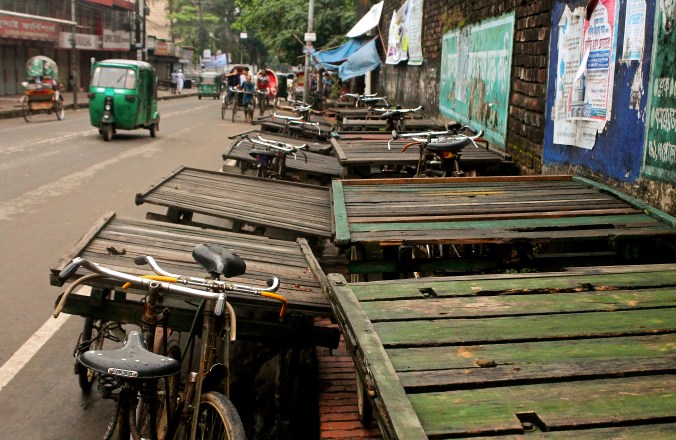
Back in March I spent a week in the south west corner of Bangladesh. I was in Barisal Division, and enjoyed a wonderful few days exploring Barisal city and the surrounding countryside.
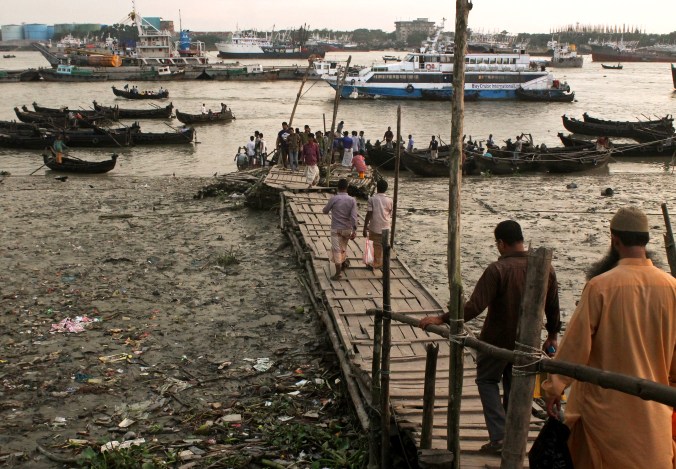
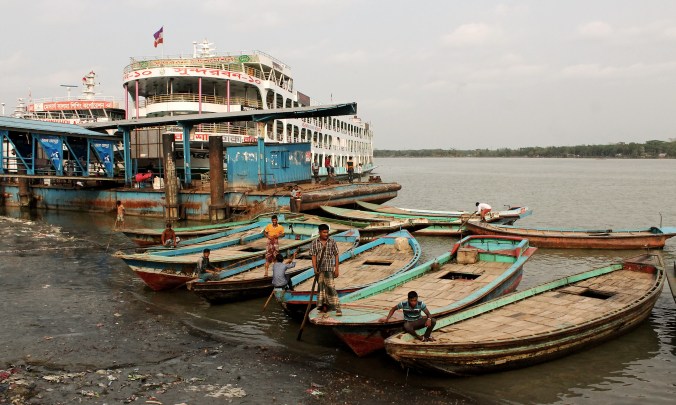
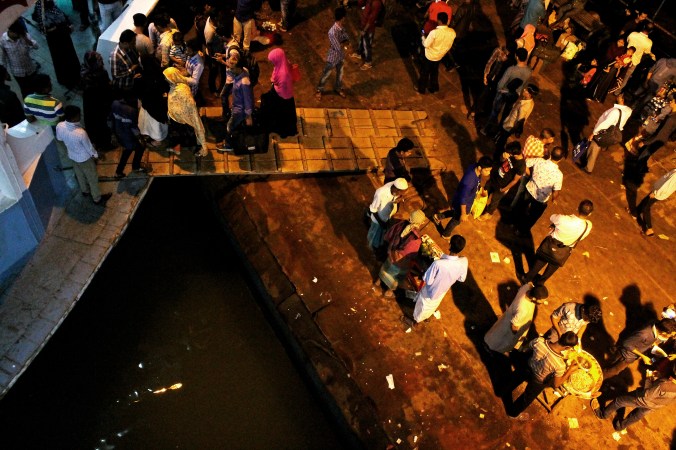
Barisal (pronounced Borishal) is essentially a port city, and during my time there several locals predicted that in some years it will become one of the most important in South Asia. At present though it’s a fairly relaxed port and doesn’t match Chittagong for its activity and freneticism.
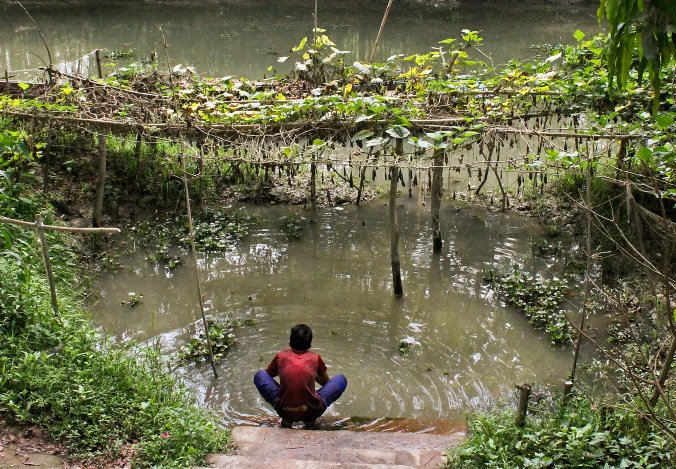
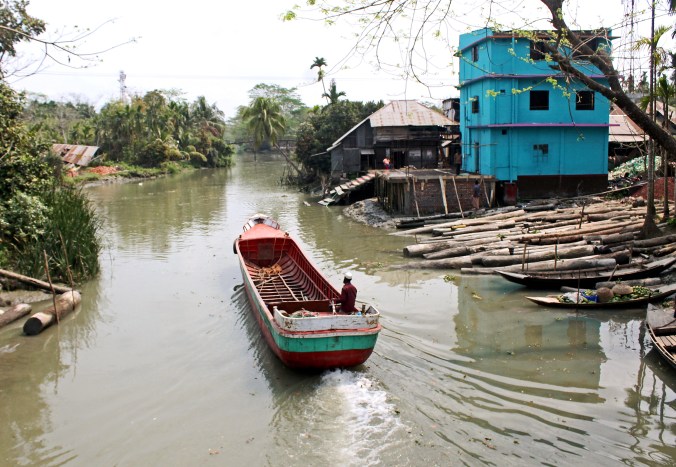
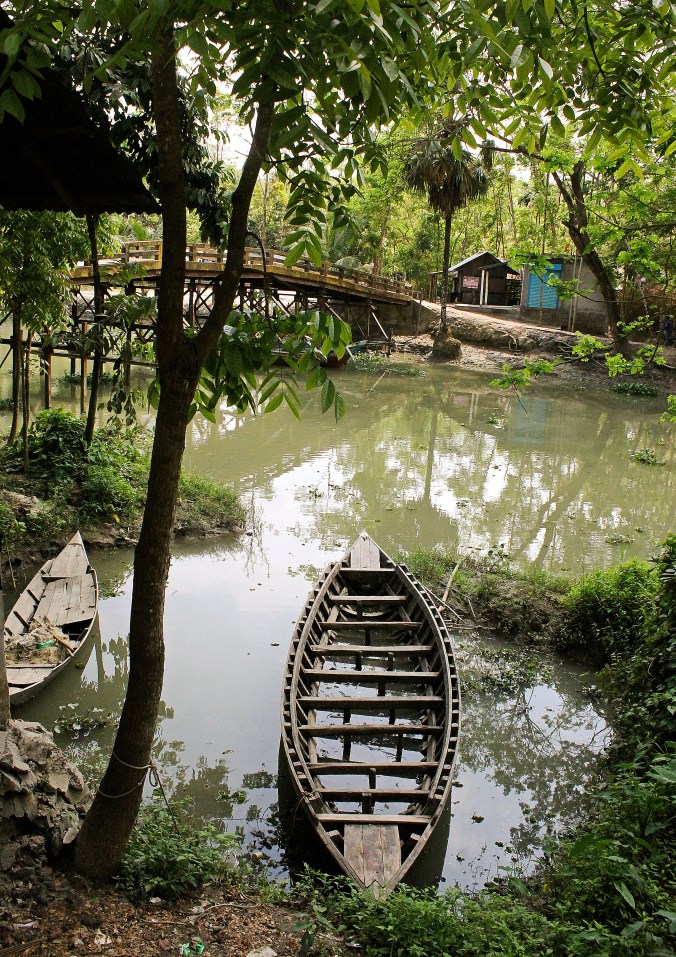
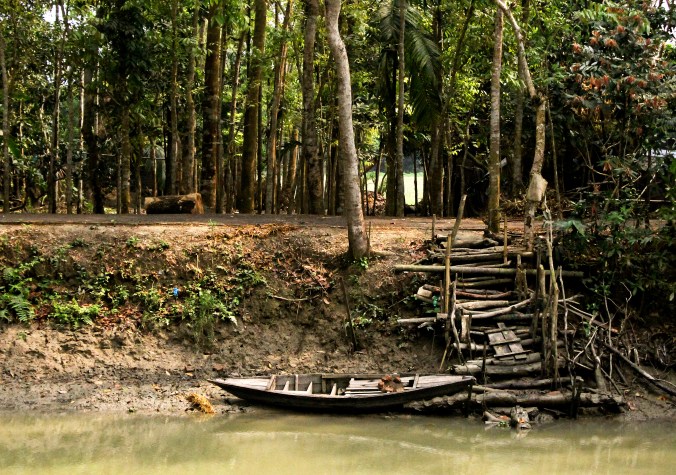
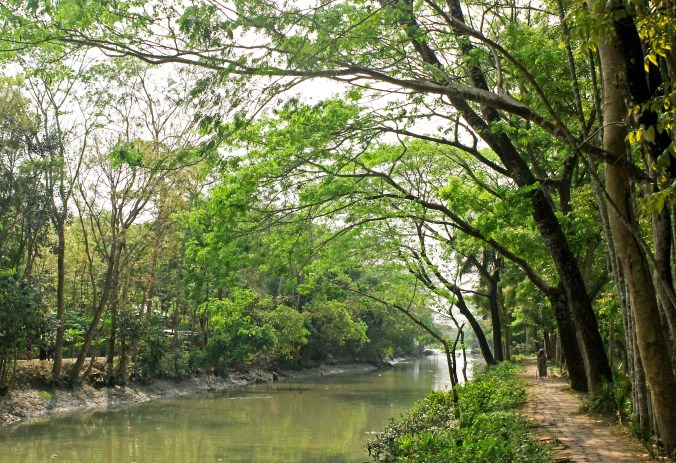
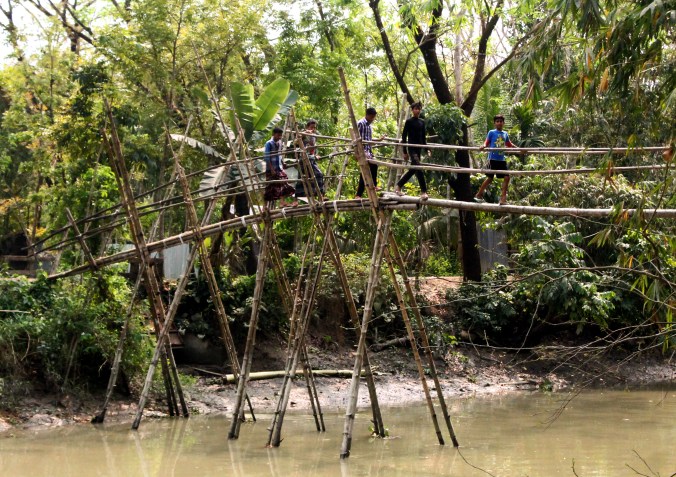
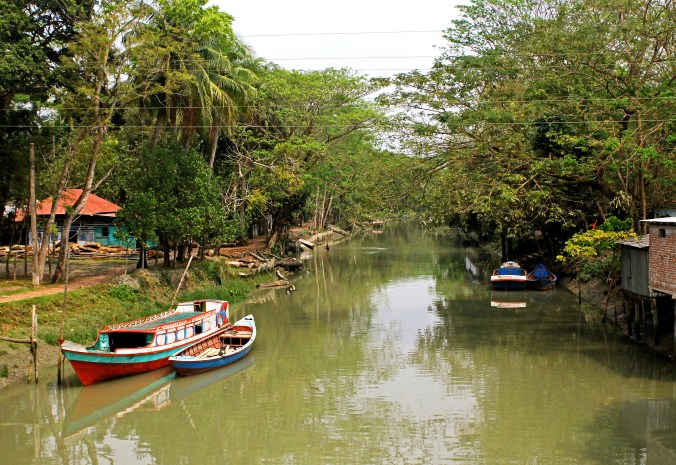
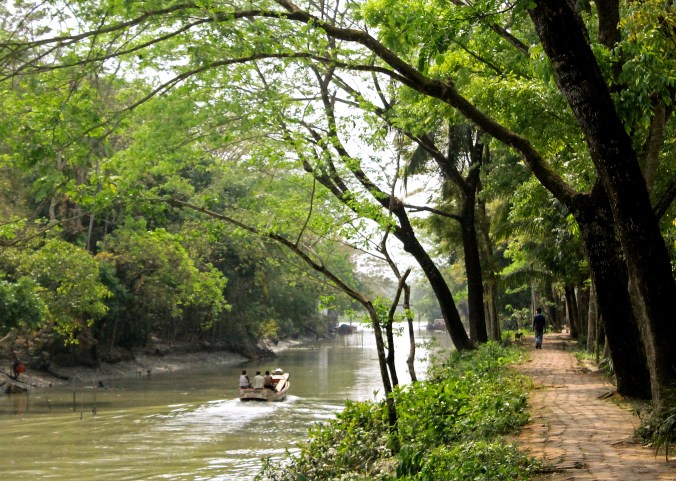
The area is also known for its abundance of rivers, which cut through the land and inspired some to crown this area the ‘Venice of Bangladesh.’ As I roamed the countryside, it was easy to see why,.
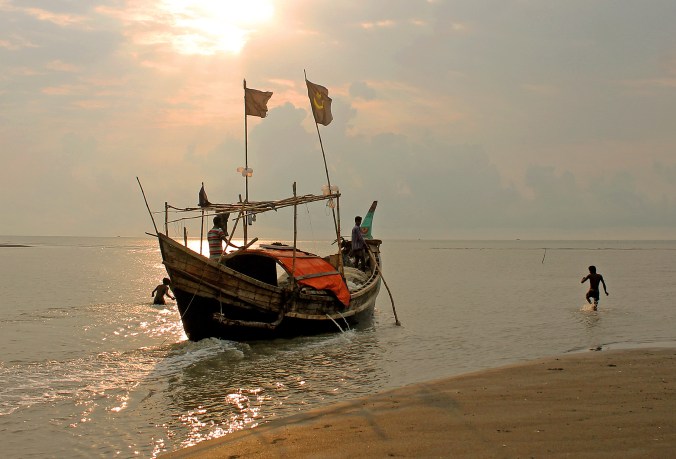
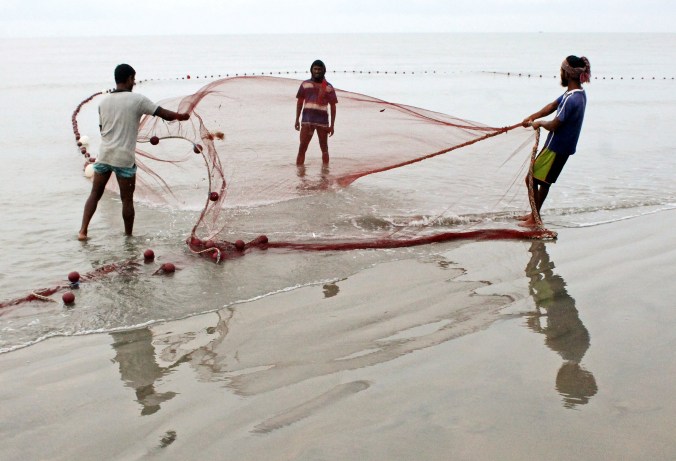
I also made a trip down to Kuakata, a peaceful and as yet largely underdeveloped seaside town, which sits at one of the southern most points of this country. Known for its long beach that stretches for 18 kilometers along the coast, Kuakata is also an attraction for visitors due to the unobstructed views of both the sunrise and sunset peacefully enjoyed here daily.
As in previous blog posts, I will let my photos tell the story of my week in the south west of this beautiful country. The title of this post is a lyric from Amar Shonar Bangla, the national anthem of Bangladesh, written by Rabrindranath Tagore.
It’s a beautiful song and for the most part celebrates the natural charm of this land. “Chirodin Tomar Aakash” literally translates as, “Forever your skies,” and comes from the full lyric, “Chirodin tomar aakash, tomar baatas, ogo aamar praane baajay bashi.”
This means, “Forever your skies, your air, plays a flute in my heart.” It’s an ode to this region of the world that never fails to delight, and for good reason, instigates immense pride from those who live here and call it home.
The name was etched, deep into my mind by the end of the day, and it’s my own fault quite honestly. My chosen method for traveling within Bangladesh more often than not exposes me to a carnage that rears its head when I decide to select a random name on the map and voyage there. This carnage is obviously caused entirely by my own doing rather than the location I would like to point out.
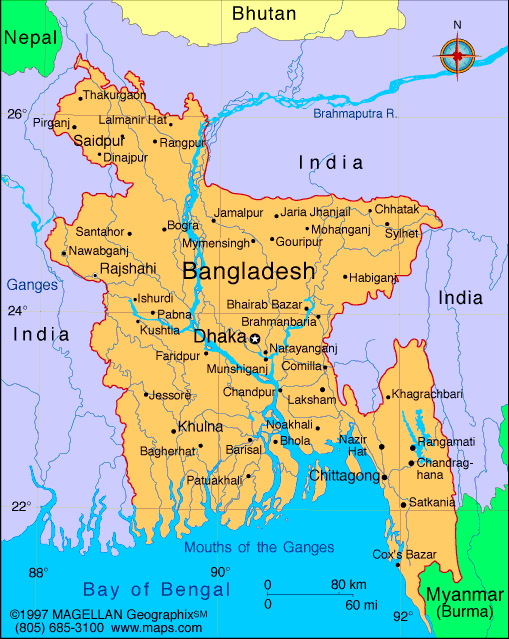
When I began writing this post, I was in Barisal, and as the map below indicates, this is a region in the south west of Bangladesh, which in many ways encapsulates the stereotypical image people hold of this country; one of endless rivers and waterways, of dense, green paddy fields, bustling markets, and incredible hospitality.
Anyway, back to the now infamous (in my mind at least) Sho-ro-di. I made the decision to venture to a place which bore no mention in the Lonely Planet guide for the Barisal region. I’ve adopted this method previously on my travels within this country, and if truth be told, it tends to deliver mixed results.
Today was no different. I scoured the map for a little while and searched names of towns or villages that lay within an hour by bus from my base in Barisal. The reasoning being that one hour is far enough to feel a little adventurous, but close enough to (hopefully) avoid becoming stranded by nightfall. There were three or four contenders, but in the end I settled on Charadi, which in my misinformed mind was pronounced Cha-raaaa-diiii.
Having identified my chosen place for the day, I filled my bag with the essentials for such an escapade. A fully charged camera, water, sufficient taka, and of course sun cream (for the weak, fragile body I possess), and upon leaving my hotel room, I was filled with the familiar sentiments of excitement and trepidation.
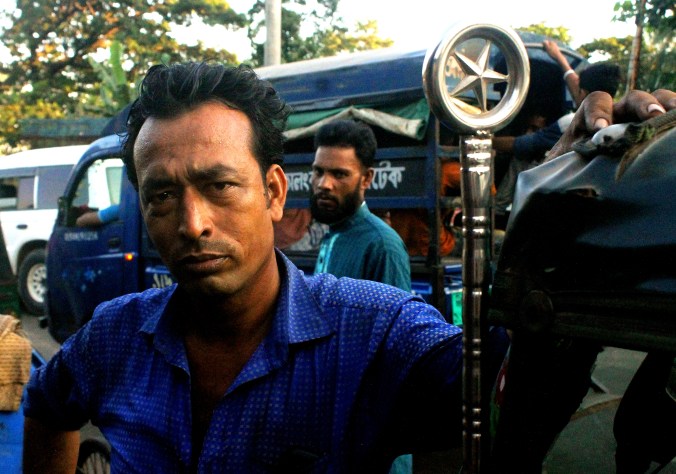
The hotel manager kindly told me which bus terminal to head for and thus I confidently requested a waiting rickshaw driver to take me there. He had a broad smile and the stained, red teeth of a man who regularly chews tobacco.
Traffic was congested with early morning commuters, heavy goods vehicles and sporadic roadworks. Nevertheless, undeterred by this and the increasing heat, my driver ploughed on resiliently and with a kind of do or die attitude that whilst admirable, made for an anxious journey…on my part. Anyway, we reached the bus terminal and I bid farewell to the rickshaw driver and part one of the mystery tour was done.
Or so I thought. It became apparent in no time at all that reaching Charadi would not involve the straightforward task of jumping on a bus. Failure to acknowledge the vital component of correct pronunciation was my first mistake, and when I greeted the bus counter chap with Cha-RA-di, a blank look faced me. I then tried CHA-ra-di, which once again drew puzzlement. Cho-ra-di, Cha-ro-di, Chooooo-od-iiii, Chaaa-raaaa-di, Cha-laaa-di, Cho-looo-di, all followed, until finally someone gasped excitedly, “SHO-RO-DI!” and there were knowing nods all round.
Relief and joy soon turned to disappointment however, as it turned out this was not the correct bus terminal at all, and after the small conference involving me, three men from the bus terminal, one man from the adjacent tea shop and approximately seven other interested onlookers, which eventually identified Sho-ro-di as my desired destination, it was concluded that I was to head back in the exact direction I had just come from.
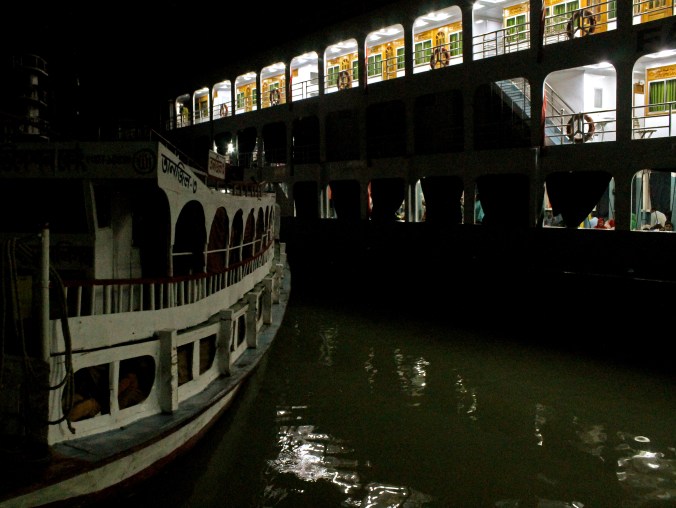
The day was young however, and I was still in relatively high spirits, so this detour in no way hampered my enthusiasm…yet. I made my way to the launch ghat (ferry port), but frustratingly my mastery of the pronunciation was once again below par and this time it took two policemen, one ticket vendor, and three recently disembarked ferry passengers to decipher my ramblings. “Aaaaah, Sho-ro-di!” once again filled the air with a mix of triumph and relief.
A small boy was enlisted to guide me to the correct boat. One minute he was sat minding his own business, and the next he’s leading me through a small market to the water’s edge. He did earn 20 taka for his due diligence and effort though.
After a short journey on a small passenger boat, I arrived on the opposite riverbank and a kind, older gentleman directed me to the bus I needed to reach the now almost mystical town of Charadi. To be honest I don’t think a great many foreigners ride the local bus to this town, so my presence generated a few double takes.
Initial impressions of my destination were not altogether positive. The first part of the bus journey involved a broad and dusty main road, littered with plastic bottles and other trash, and I wondered if the beautiful scenery that I’d set out to capture with my camera lay somewhere faraway from here, perhaps right back in the opposite direction, but as we took a left turn off the main road, my hopes for Charadi picked up.
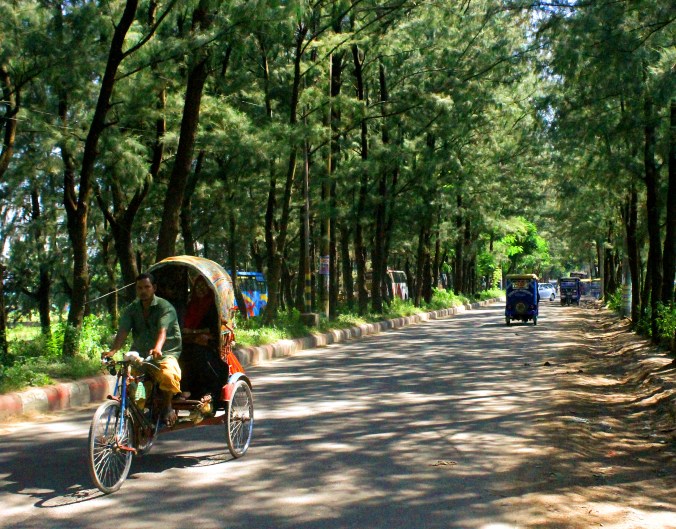
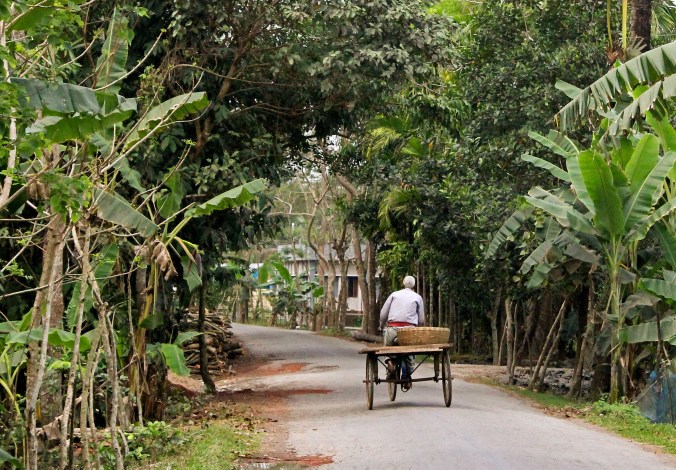
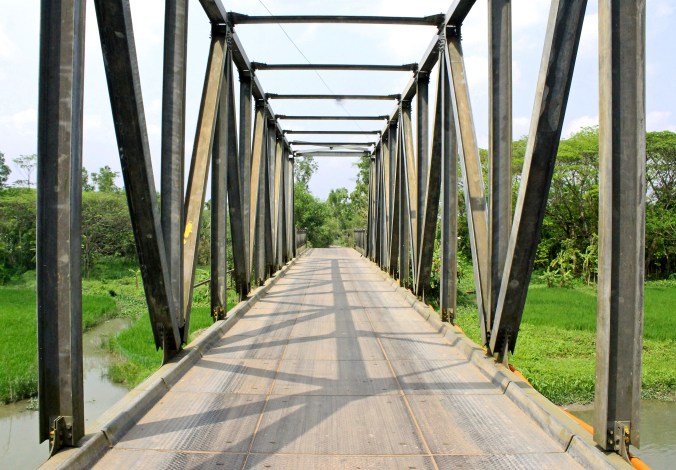
While the road quality deteriorated, the surrounding countryside did the exact opposite and seemed to be rejuvenated with a surrounding landscape of dense green trees and glistening streams. Small villages bordered the winding, bumpy road, and after about fifteen minutes of this view through the bus window, we came to a halt. I had made it, some two hours after setting out.
Over the course of the subsequent hours, I spent my day drinking tea, wandering through the small town and neighbouring countryside, and even visited a local primary school!
Was it worth it? Well, hopefully the following photos will answer that question better than words can. However, what I will say briefly is that I once again encountered a beautiful corner of this country, and in my next blog post I’ll share a series of photos from a week spent in the south west, which will hopefully demonstrate the incredible joy of travel and adventure.
Charadi was a quiet and peaceful market town, sat on the bank of a river, which I strolled along for a while. My challenge in reaching here was due in main to my sub-standard pronunciation and short term memory loss. To be perfectly honest as I stood, forlorn and desperately trying to communicate the name ‘Charadi’ to a fairly large audience, I couldn’t help thinking of this video from Disney’s Pete’s Dragon…
I like milestones. They provide a satisfying sense of accomplishment and achievement whilst ensuring the preservation of a little focus and direction.
This post is a celebration of one such milestone. April 9th, 2016 marked exactly 5 years since I first posted on this blog. It’s a pleasant feeling to know that despite the many twists and turns, the sporadic uprooting, the hellos and the goodbyes, and the often unplanned wanderings, I have still found time to regularly (well, kind of regularly) update and commit part of my energy and heart to this little project.
A project that began with the somewhat vague aim of recording my ramblings has now grown into a means by which to document a multitude of experiences that came along the way.
What this milestone also represents is that it is now a little over five years since I arrived in Bangladesh. When I think back to that time (March 2011), I really had no idea I would remain so long in this country, but I don’t regret it one bit. I arrived on a short term contract with a cautious ambition to perhaps extend that to a year. Five years on I’m still here aside from a one year sabbatical (of sorts) in Guyana.
Bangladesh has been good to me, and I am very grateful for that. I can’t really believe how quickly the five years have flown by, but in that time I’ve been lucky enough to explore this country a little and also travel to Nepal, India, Cambodia, Myanmar, Vietnam, Sri Lanka, Laos, Bhutan, Thailand, and even back to Rwanda a couple of times.
Most importantly though I have been lucky enough to work in a job that has inspired me to grow and learn. I’ve been surrounded by some fantastic colleagues right from the start, and they have been a source of constant knowledge whilst encouraging me to change and develop my outlook on many, many things.
I have of course also been privileged to teach and work with students who have taught me far more than I have them.
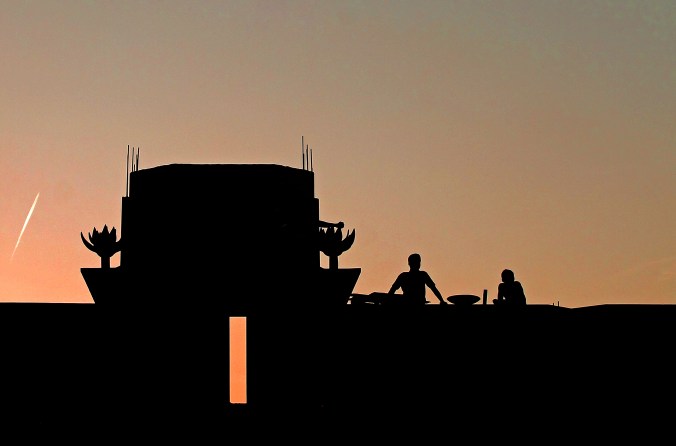
As always with these short posts that mark a milestone, I prefer to let images tell the story, so here are a few which I think sum up just why that tentative first few months turned into five years and provided me with so many amazing adventures under this one sun.
One of the most frustrating aspects of social media is the simple fact that stories about complete idiots are thrust directly in front of your face on an almost daily basis. Anyone who saw my Facebook page in the past week or so may have noticed one such story.
The news I’m referring to is surprisingly not about Donald Trump, Jeremy Hunt, or Sepp Blatter (although this trio are worthy contenders), but rather revolves around a group of people who epitomise the ignorance and disregard demonstrated so often by the human race to other creatures.
A dolphin plucked from the water and passed around like a trophy so that bronzed beachgoers of all ages could pose and take ‘selfies’ with it. Once the selfies were complete, the dolphin had inevitably died. Because you see, what these humans had so crucially forgotten, is that dolphins can’t survive for prolonged periods outside of water, and what those people now have on their cameras, or smart phones, or whatever they were using that day which caused them to lose all sense, is a selfie with a dolphin who died because of them.
It happened in Argentina, but this could be anywhere in the world, and the flagrant disregard for the life they passed around in their hands that day sums up the arrogance and sheer contempt we, humans, demonstrate on a daily basis.
It left me totally exasperated once again, as it seems there is not a week that passes without tales of sheer moronic stupidity claiming yet more animal lives. Whether it is a wealthy dentist shooting an innocent and treasured lion, Russian circuses forcing polar bears to dance, or puppies used for target practice, there is no limit to our cruelty and indifference.
However, despite all of this, there is hope, and I have witnessed a few examples here in Bangladesh.
Obhoyaronno is an animal welfare foundation formed in Dhaka in 2009 and has carried out some fantastic work mainly in the Bangladesh capital to rescue animals and educate the local population about animal welfare issues. The organisation has successfully campaigned to have dog culling in Dhaka cancelled, and they regularly carry out dog vaccination programs in the city. They have a large community now of like-minded people who will alert others about any cases of animal abuse or animals in trouble.
Dog Lovers of Bangladesh is an inspiring facebook page dedicated to, well…dogs of course. The members on that page never fail to amaze me with their dedication to the welfare of dogs here, and there are often emergency posts regarding an injured or distressed dog sighting. It is not uncommon for this to be followed by an immediate and robust response from other members of the group who mobilize and swiftly locate the dog, whilst doing all they can to source the care it needs. Other members often chip in with cash donations, and before you know it, a dog once destined to lie dying next to a busy road, has been scooped up and given the life-saving treatment it so gravely needed. The members of this group are caring, conscientious animal lovers who provide a reminder that all is not lost.
Finally, there is a group somewhat closer to home for which I have the utmost admiration; The Asian University for Women (AUW) Animal Welfare Club. Created just over two years ago, the club has grown steadily and in that time initiated a number of projects aimed at implementing clear strategies for improving the welfare of animals.
Photo credit: Dhrubo (Dhrubo Photography)
In truth due to the modest size of the club and its limited financial capacity, the focus has been on street dogs and cats. However, the lack of funds has been no deterrent to the club members, and driven by their passionate club president and founder, Mandy Mukhuti, they have already played a significant role in making tangible changes in the lives of many animals.
Since its inception in 2013, the club has visited primary schools to educate young children on how to treat animals. They have also initiated a daily feeding program, which entails collecting leftover food and feeding street dogs in the vicinity of the campus. The success of this is highlighted by the fact these dogs now know and recognise the members of the club when they come calling with their plastic container full of food!
Photo credit: Dhrubo (Dhrubo Photoography)
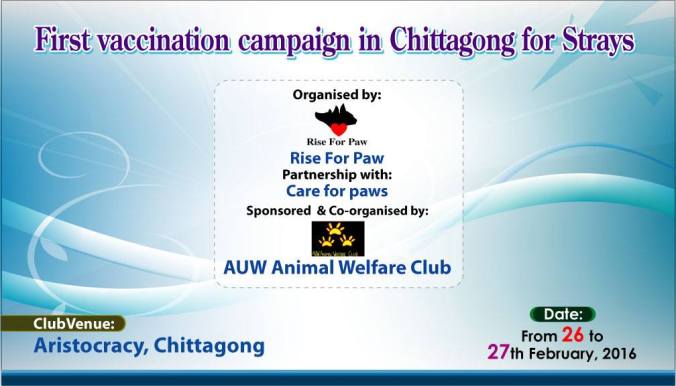
The club has also rescued several cats and dogs and successfully found homes for many of these animals. Finally, this past weekend they arguably reached the peak of their success thus far. Having spent a few months raising necessary funds, they teamed up with local veterinarians and students from other universities and set about successfully vaccinating two hundred dogs across the city in just a single weekend! It’s a remarkable achievement given the constraints they experience and a testament to their passion and commitment to such a worthwhile cause.
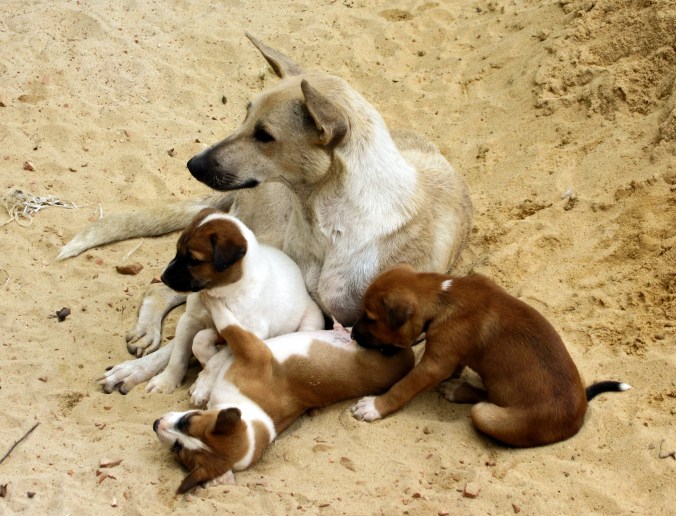
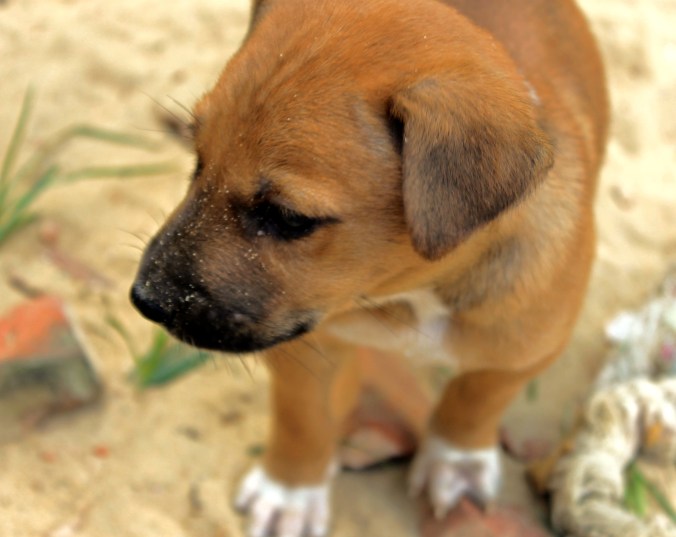
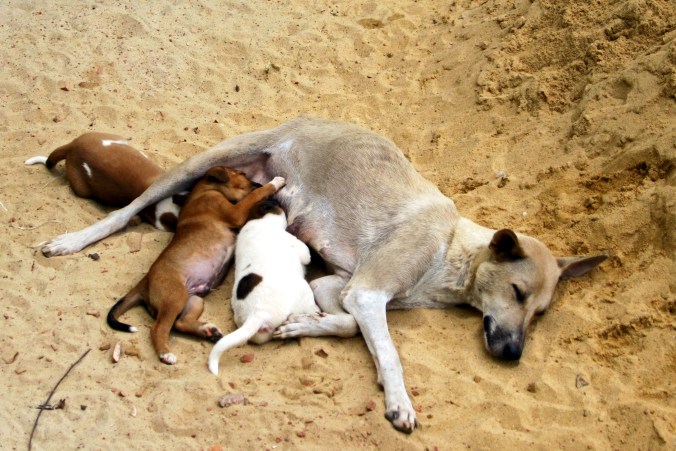
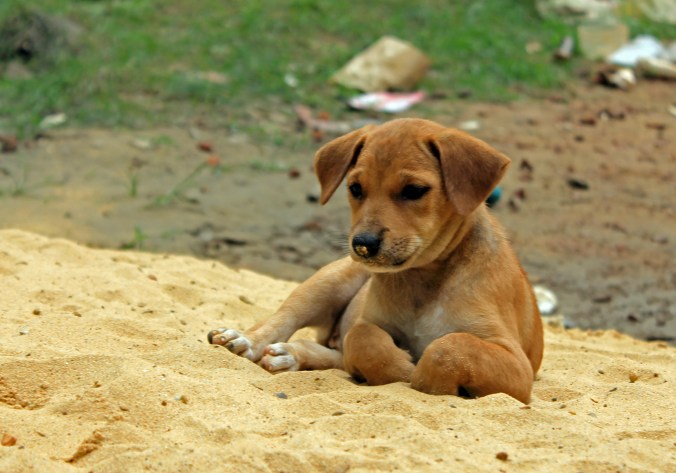
I’ll leave you with a collection of images taken during my time here in Bangladesh, which show a number of the animal friends I’ve made. This family lived behind our building and the puppies provided hours of fun, yet immense stress! We managed to find homes for most of them, but a couple sadly fell victim to the unforgiving main road that lay just far too close for temptation.
Father & Son
A patient mother
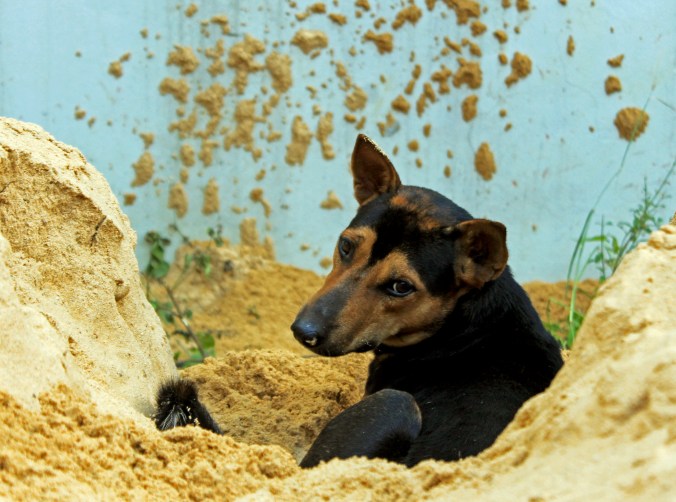
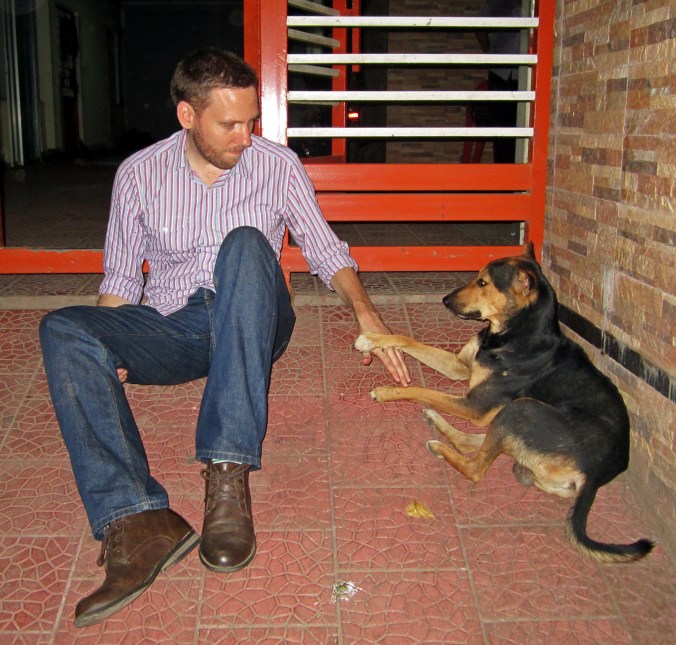
At present I also regularly feed Tommy and Rocky who live on our road, and whilst this is just a very tiny act, I believe that the bewildered, yet intrigued gazes I receive as I sit feeding the dogs do go some way to showing people that these dogs are not angry beasts who should be avoided at all costs, but actually friendly animals who just need a bit of love and a friendly face.
Step by step we can make a difference, no matter how small that may be.
So I’d like to take the opportunity to use this somewhat older (hmmm, let’s say more ‘mature’) platform of communication to tell you about a new project I’ve started working on.
I say I, but it is in fact ‘we’ – my good friend Rich and I. We know each other from our days in Prague when we both completed the same TEFL course (Teaching English as a Foreign Language) and have remained good friends ever since.
Rich still lives and works in the Czech Republic in a town called Podebrady, and he came up with the idea of creating a Vlog (video log) in which we both contribute regular videos offering a little glimpse into our individual experiences in the Czech Republic and Bangladesh respectively.
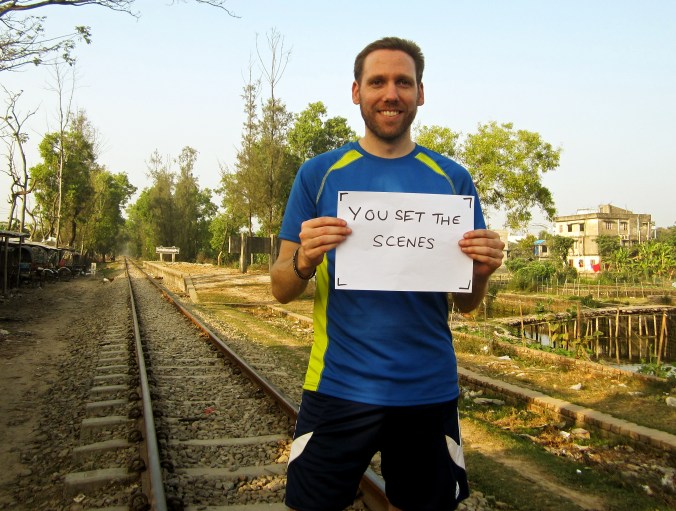
The slight twist is that in doing so, we will set each other various challenges. We will also seek input from our viewers (who will hopefully exist!) and ask for suggestions for challenges they would like to see us complete, hence the name of the vlog – You Set The Scenes. Also, crucially, whoever receives the most thumbs up on youtube for their video wins the challenge.
*The name of the vlog is also a little nod to one of my favourite songs by one of my favourite bands.*
The main aims of this new project are as follows:
For Rich and I to keep in touch!
To hopefully offer viewers a little glimpse into what our lives are like as expats.
To offer a positive look into the culture and environment of both Bangladesh and the Czech Republic.
To motivate Rich and I to explore our locations further and hopefully create a richer personal understanding of our surroundings.
To do things we may not have previously considered, which will no doubt at some points make us appear awkward and uncomfortable…perhaps much to the amusement of our viewers (again, if we have any)!
So that’s it really. I’m sure it will be a challenge at times, but also worthwhile, rewarding and fun. We both love exploring and getting away from the ‘tourist track’ and hope that this new vlog will reflect that.
Check out the trailer…
Our first challenge was to learn and recite a tongue twister in the native language of our countries. So I learned a tongue twister in Bangla, and Rich learned one in Czech. You can see how we got on below.
It’s shamefully embarrassing to admit this, but upon reflection I think I have reached the point where I’m travelling to countries that just a few years ago I knew little, or nothing about. My move to Bangladesh back in 2011 not only introduced me to this golden land, but given that my job is teaching students from 15 different countries, my eyes and ears have been exposed to each and every one of those countries in some way. I’m undoubtedly a lot richer for that.
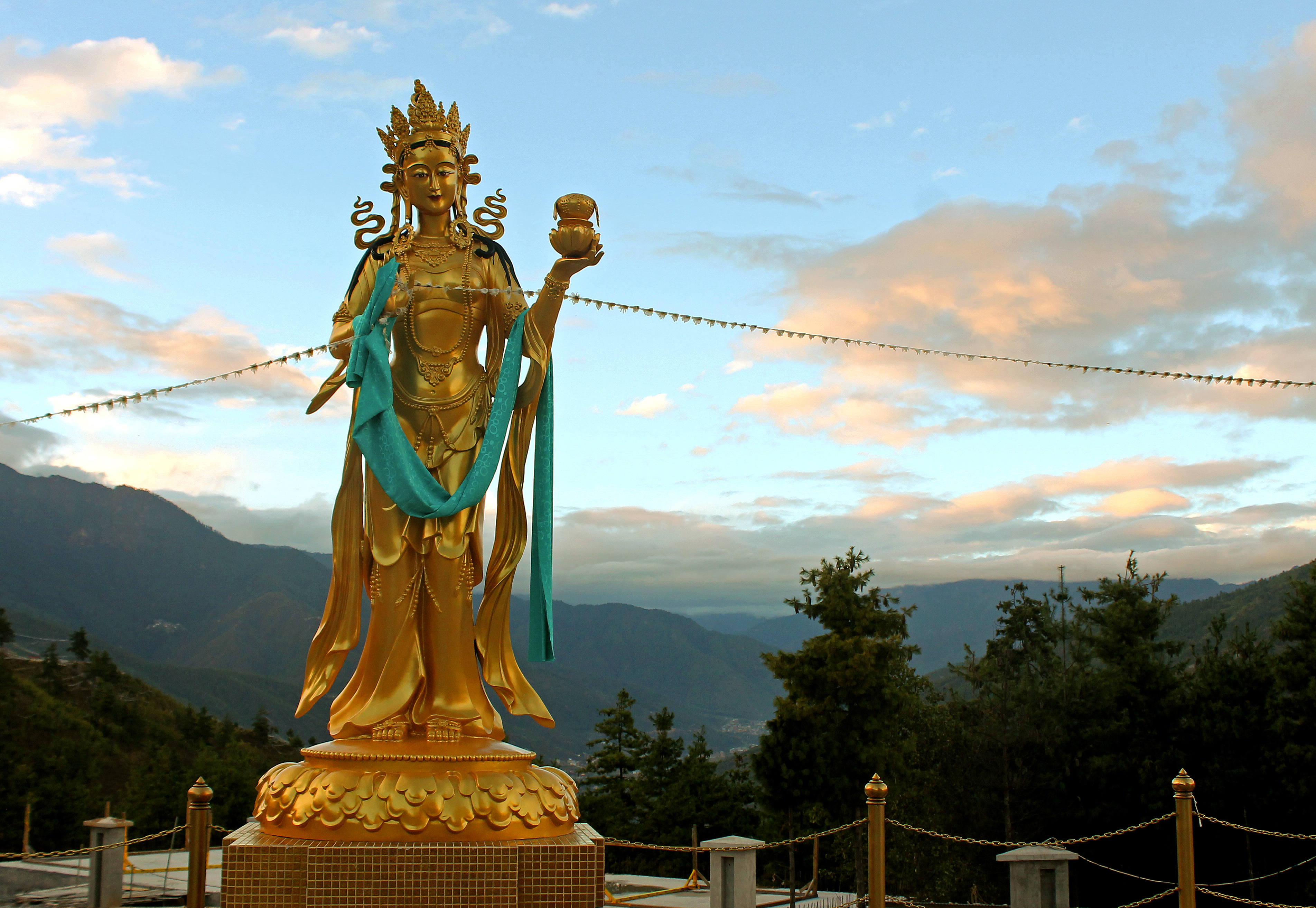
A few weeks back I finally had the opportunity to visit one of those countries that had most intrigued me, and thanks to the assistance, amazing kindness and visa office doggedness of Dechen (a former student) I was on a plane to Paro and landing in Bhutan.
Bhutan is sandwiched in a somewhat intimidating position between India and China and is unique in its policy of measuring Gross National Happiness (GNH) rather than GDP. In effect, focus is placed more firmly upon the preservation of culture with a commitment to environmental conservation and sustainable development.
Thus, it’s not the easiest of places to enter as a tourist or to roam freely once you are there. However, don’t let the bureaucracy deter you because quite frankly, it is stunning and so very endearing in many ways.
In this account of my brief stay in Bhutan, I will try to explain just why, based of course on personal experience, this kingdom of just 800,000 people made such an impression.
Here is an album with a selection of photos – Bhutan
Natural beauty
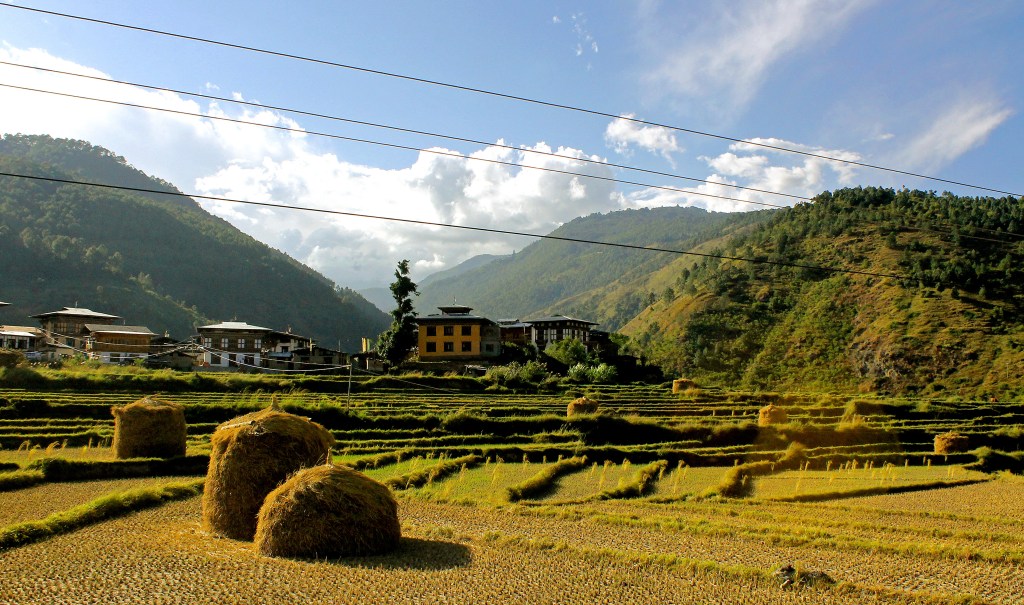
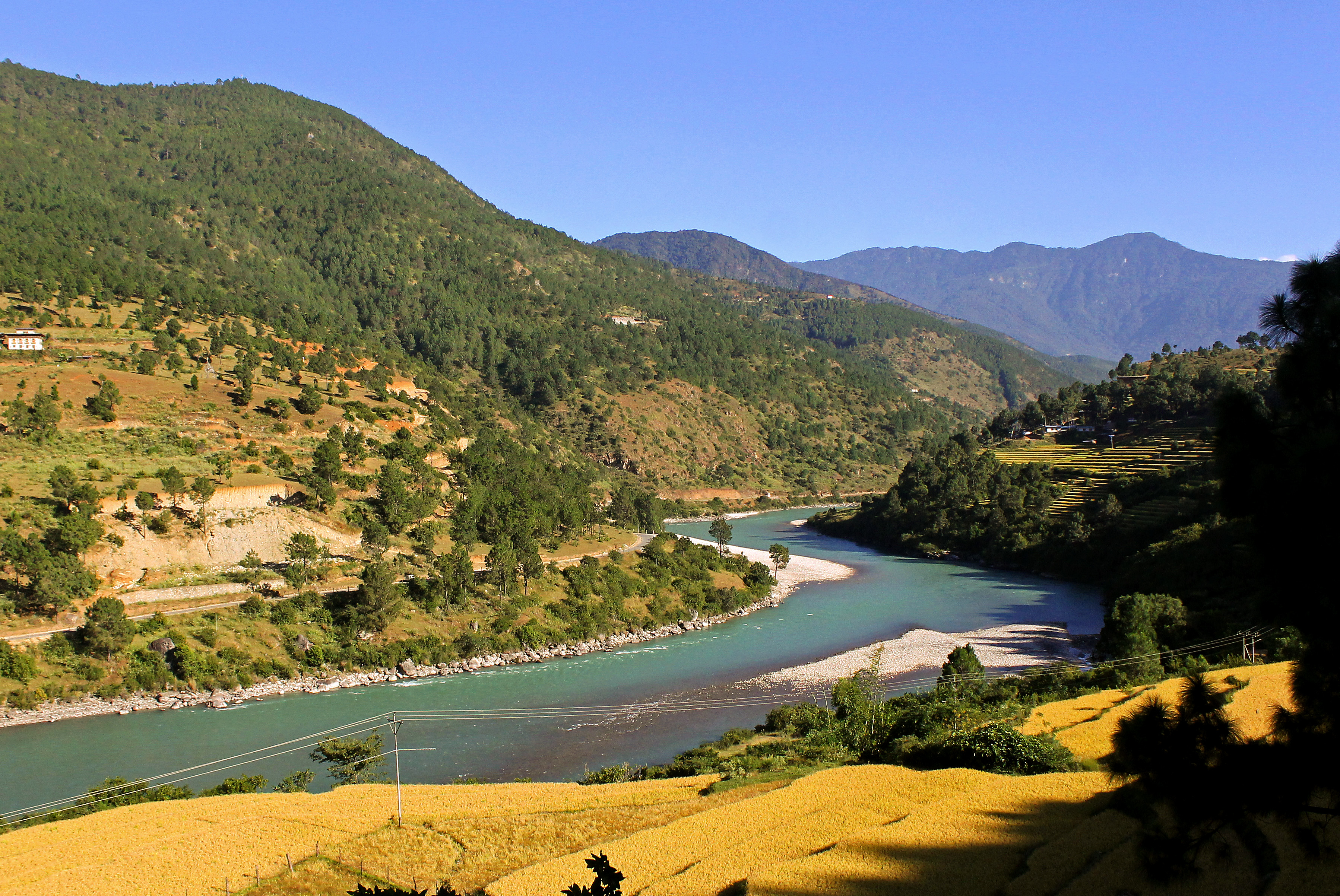
Eastern Himalayan mountains, deep and dramatic valleys, winding rivers, dense forests, fertile pastures, and wide open plains all contribute to the breathtaking scenery that surrounds you. As the plane lands in Paro, it weaves between mountainous peaks and according to this article, only eight pilots are currently certified to land aircrafts there!
Preservation of culture
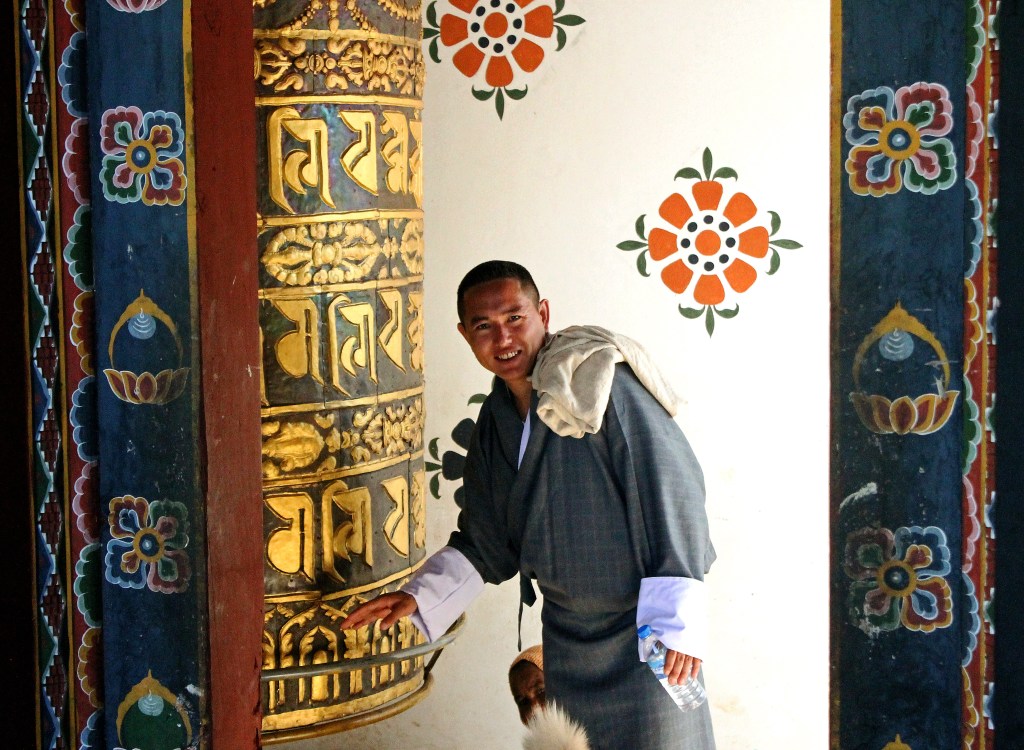
Bhutan is proud of its cultural heritage, and has taken strong measures to ensure not only its survival, but crucially its conservation and continued significance in everyday life. Television and internet is a surprisingly new feature of life in Bhutan having only been introduced (officially) in 1999.
Tourism is limited and controlled, and national dress is a must at various locations including most workplaces. There is a gritty commitment to rejecting and actively fighting those external influences that can commonly be accused of eroding traditional culture in certain other countries that have welcomed tourism with open arms.
Dechen, Pema, and Sonam in traditional dress
Road safety signs
On the beautiful winding and meandering main highway between Paro and Thimphu, which I imagine is one of Bhutan’s busiest, there are regular road safety signs that predominantly focus on reducing speed. They get their message across though in a quirky and sometimes cheeky fashion. I wasn’t able to capture any photos, but I did make a note of two in particular that stuck in my head…
“If you are married, divorce speed!”
And…
“Be gentle on my curves”
On a more serious note though, it does appear that road safety is a huge priority in Bhutan with regular police checkpoints and from what I saw a diligent appreciation of the laws in place.
Dogs
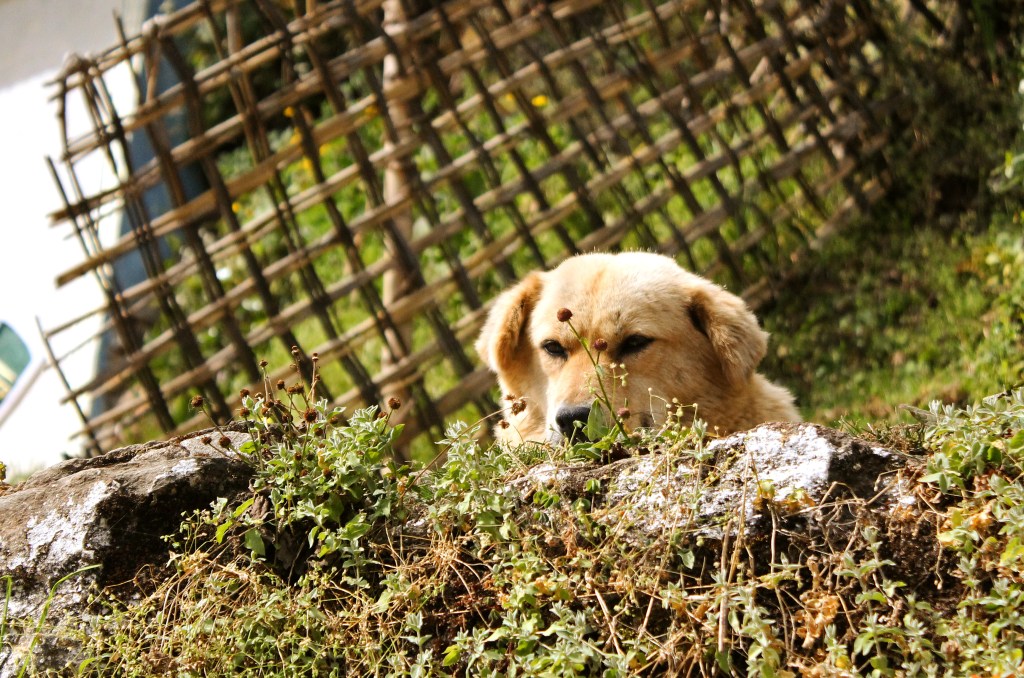
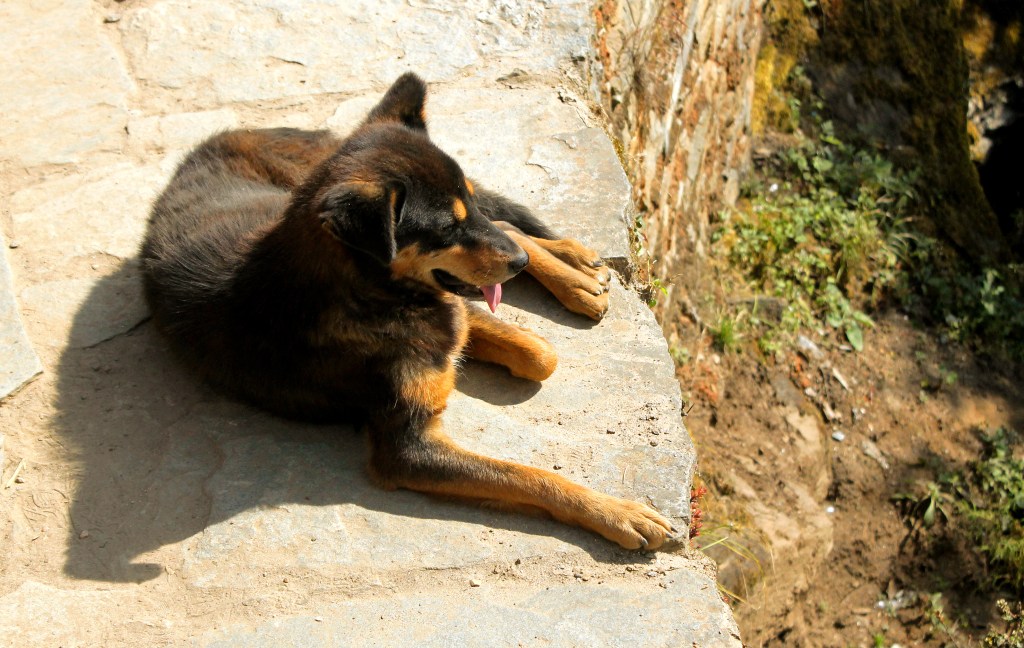
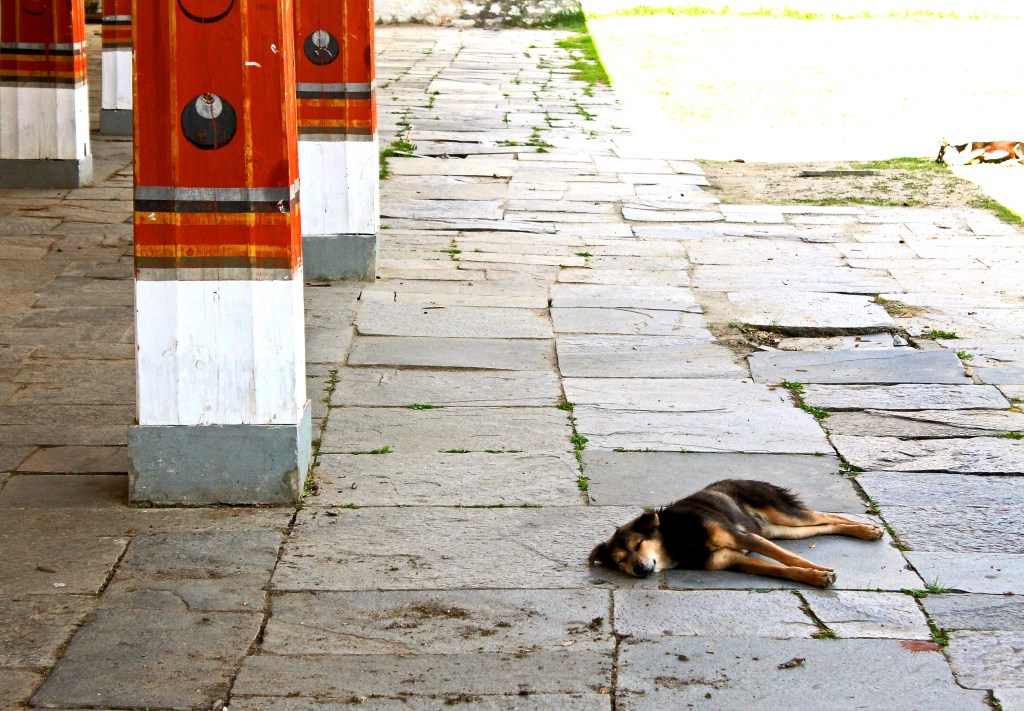
In Bhutan there are dogs….so many dogs. They are everywhere. On every street corner, under every bridge, asleep on every sidewalk and at night they serenade you until the early hours with huge canine choirs. They are also quite often big, furry things that generally add a level of happiness and warmth to an already happy and warm country.
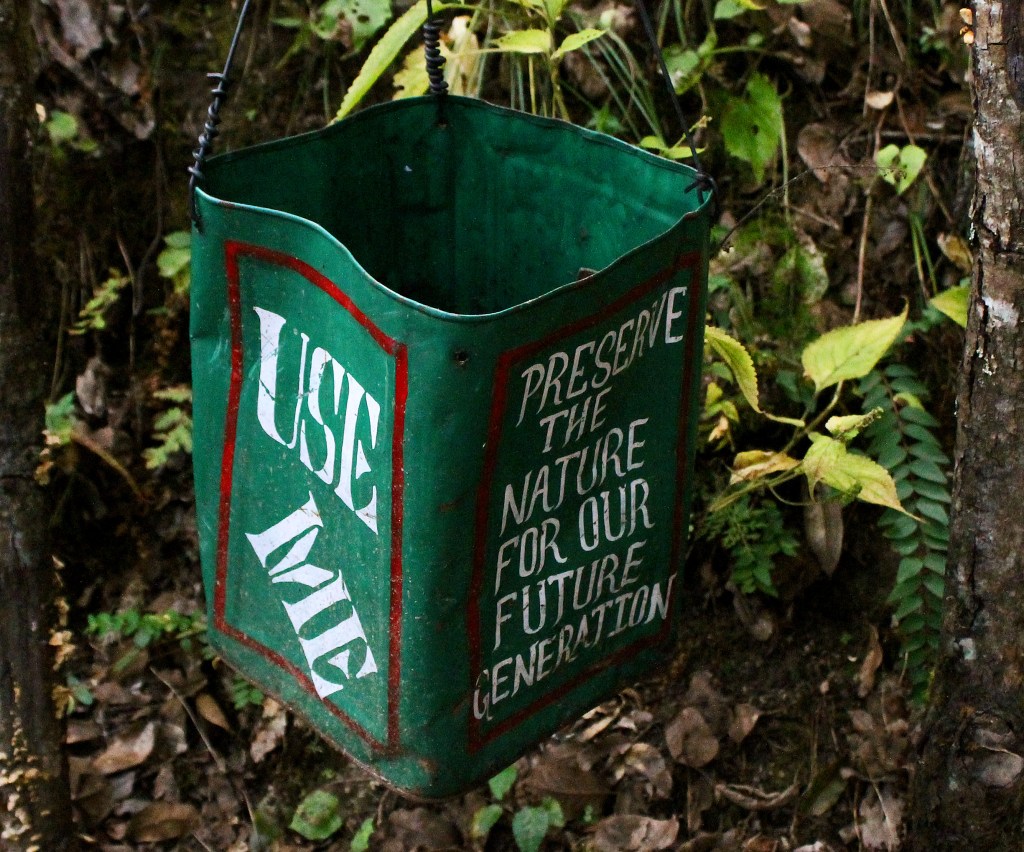
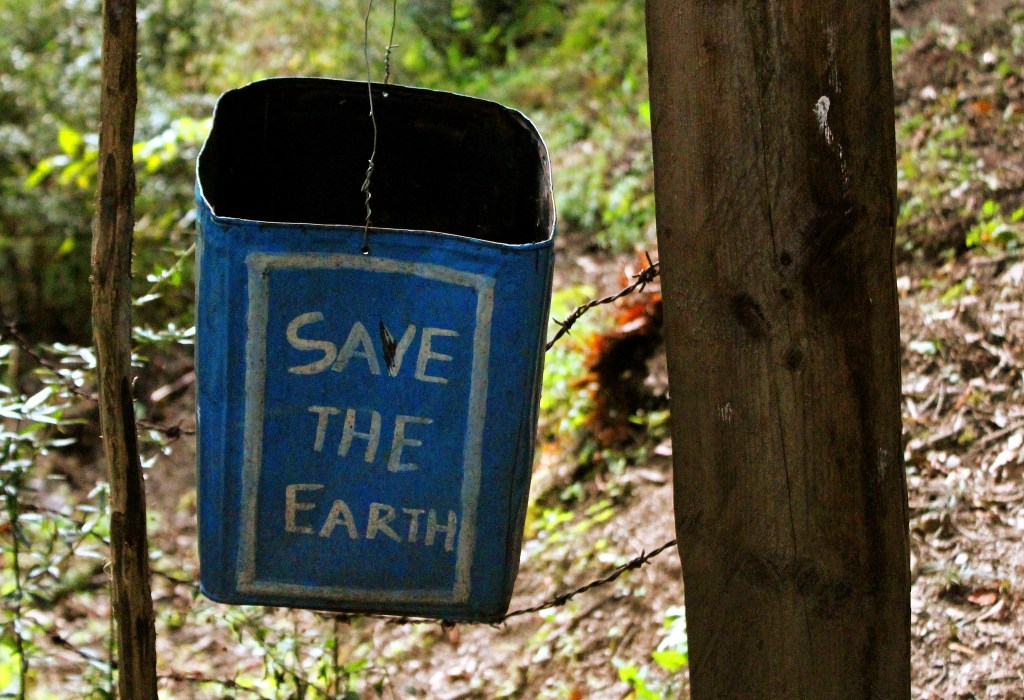
There are bins. People use them.
There seems to be a genuine commitment to, and pride in keeping the country clean. It may seem a little patronizing to point this out, but from travelling and from experiences back home in the UK, I feel that many places (and people) have abandoned their responsibility to this simple and basic condition. The bins are also covered in motivational and encouraging messages, just in case you feel the inclination not to utilize them.
Hospitality
This was not much of a surprise. Whenever I travel I encounter genuinely kind and hospitable people. Bhutan was no different, and I had not expected it to be. Before I’d even begun the visa application process, my Bhutanese students and their families had offered all kinds of help and support, and once I landed in Bhutan that help and support became even more ubiquitous.
From the man in the coffee shop who gave me a warm welcome each morning, to the friend of a friend who within thirty minutes of meeting me had paid for my dinner, it was a week full of unrelenting kindness. Special mentions must go to Dechen, Pema, Sonam, Yeshey, Kencho, and Namgay. These wonderful people made my stay in Bhutan even more perfect than it could have been.
Pema, Dechen and Sonam
Namgay – my new friend and fantastic guide for a day in Punakha
Dechen and Pema
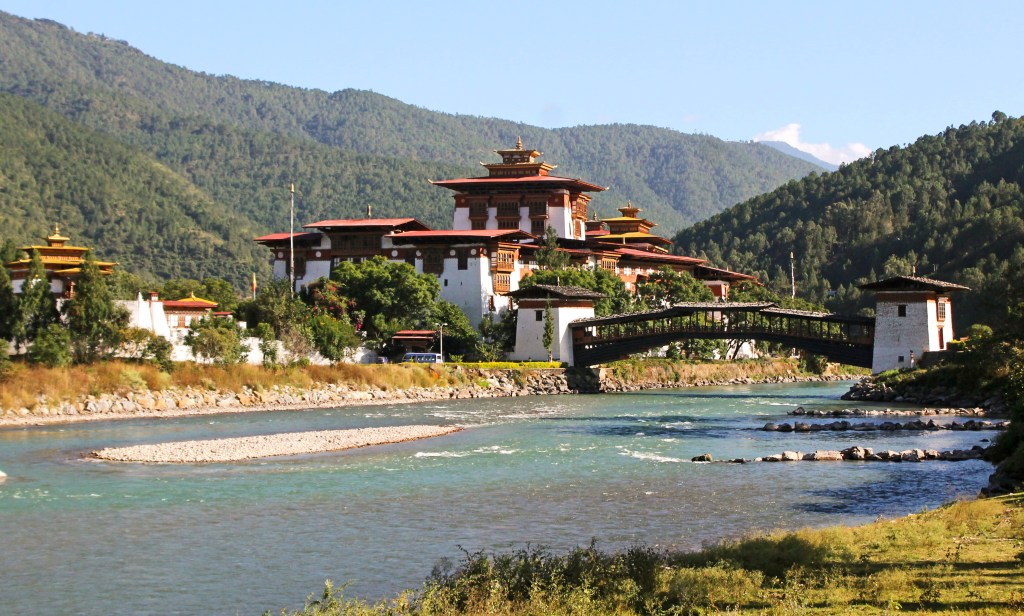
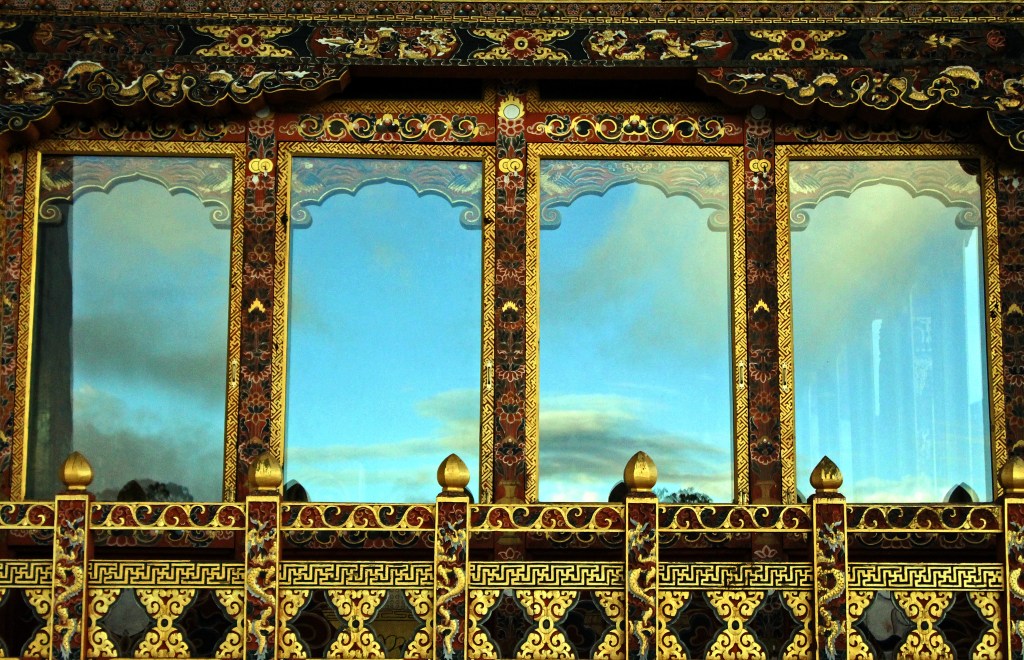
Beautiful Buildings
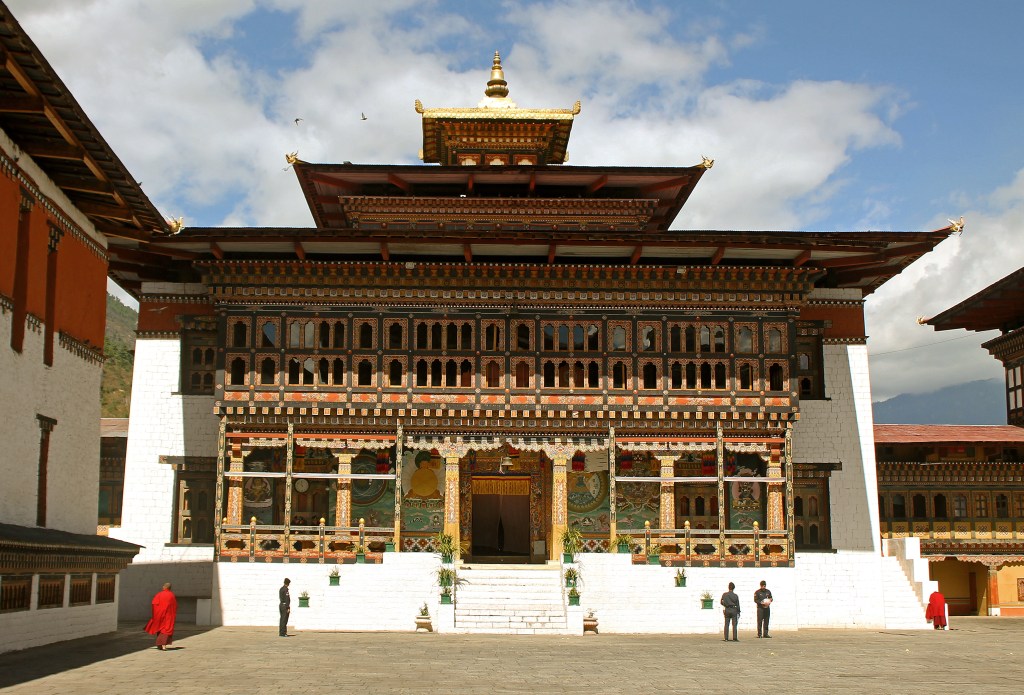
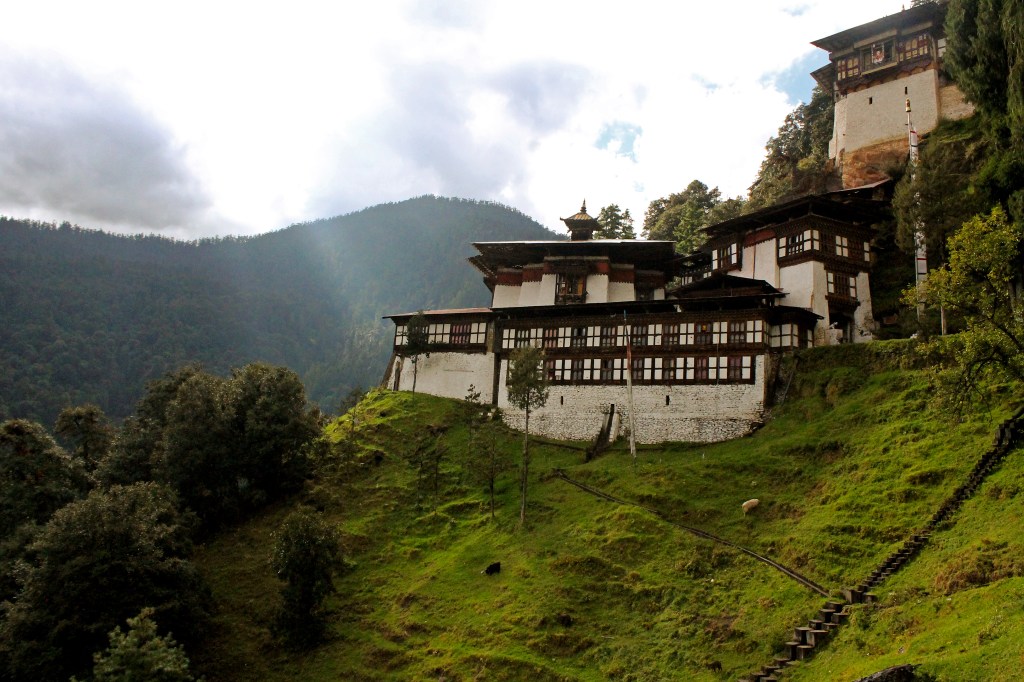
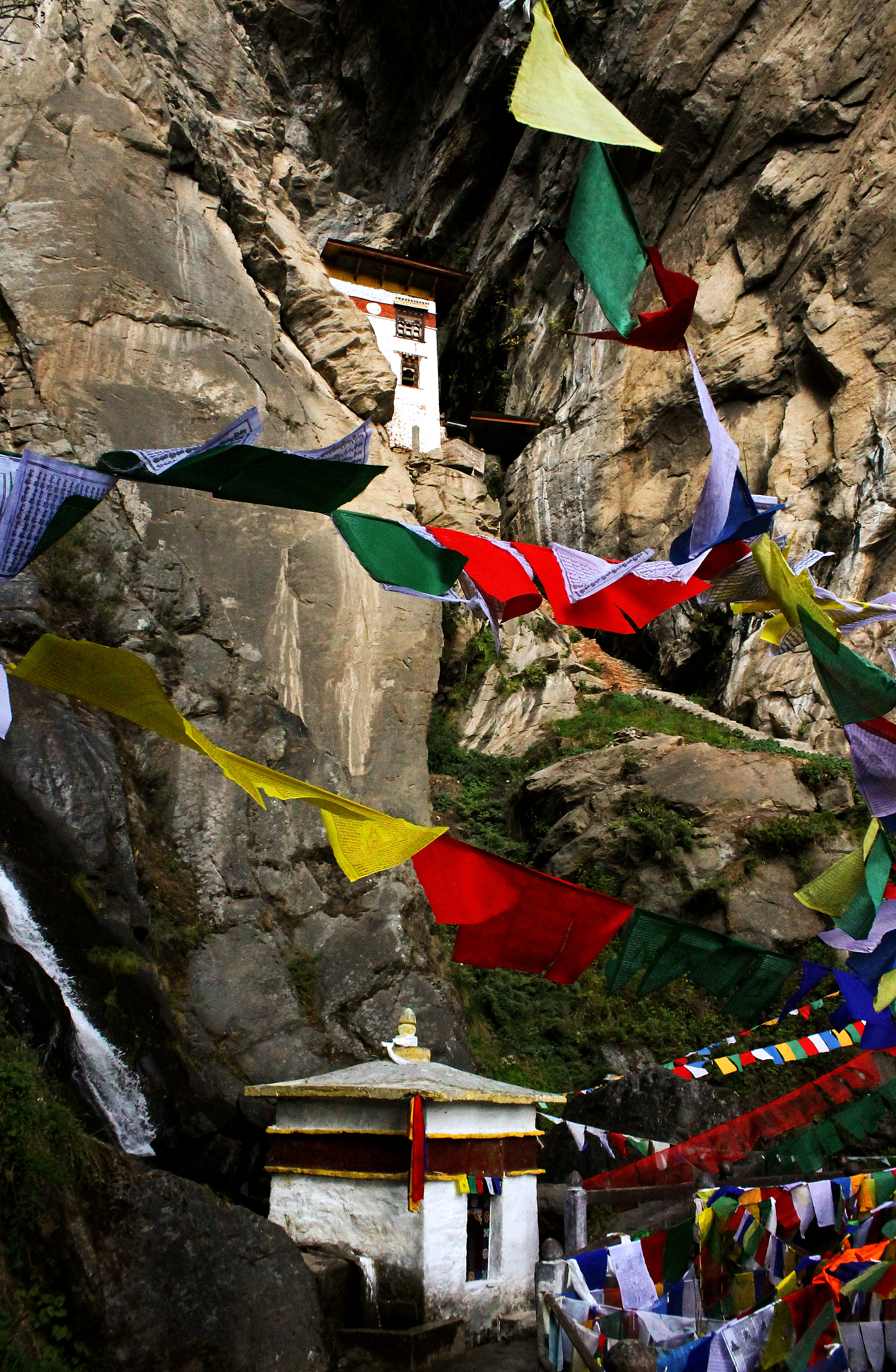
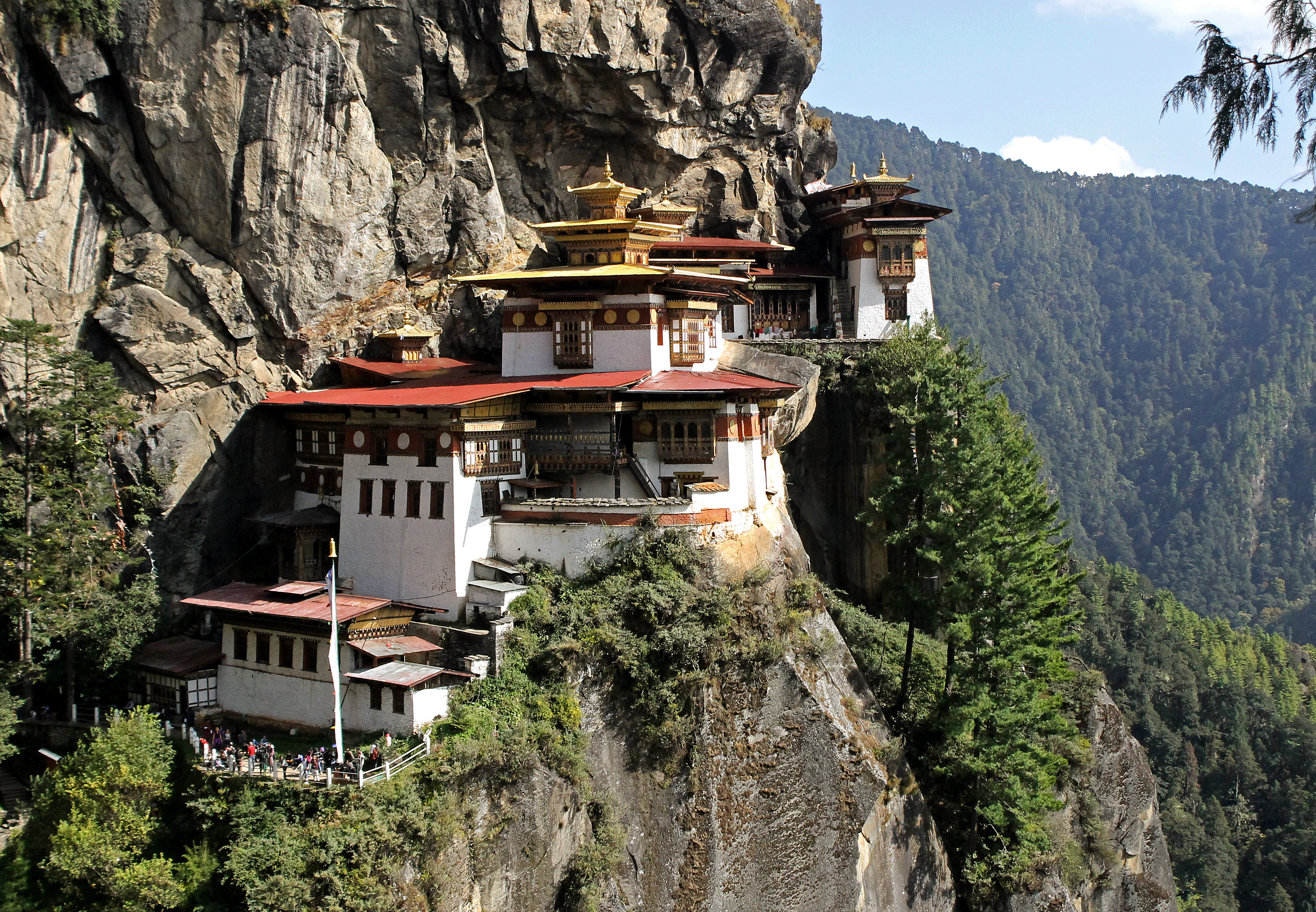
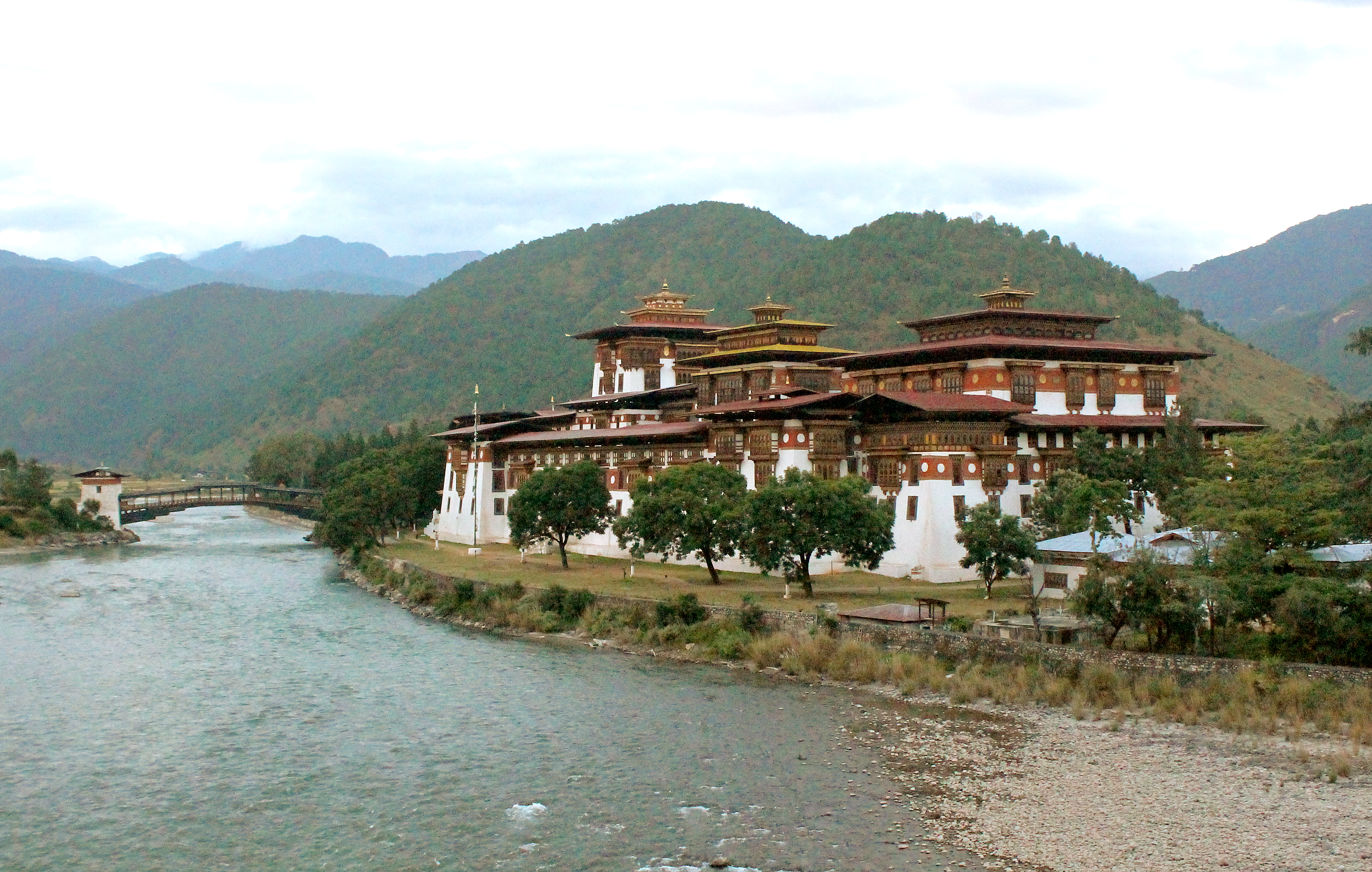
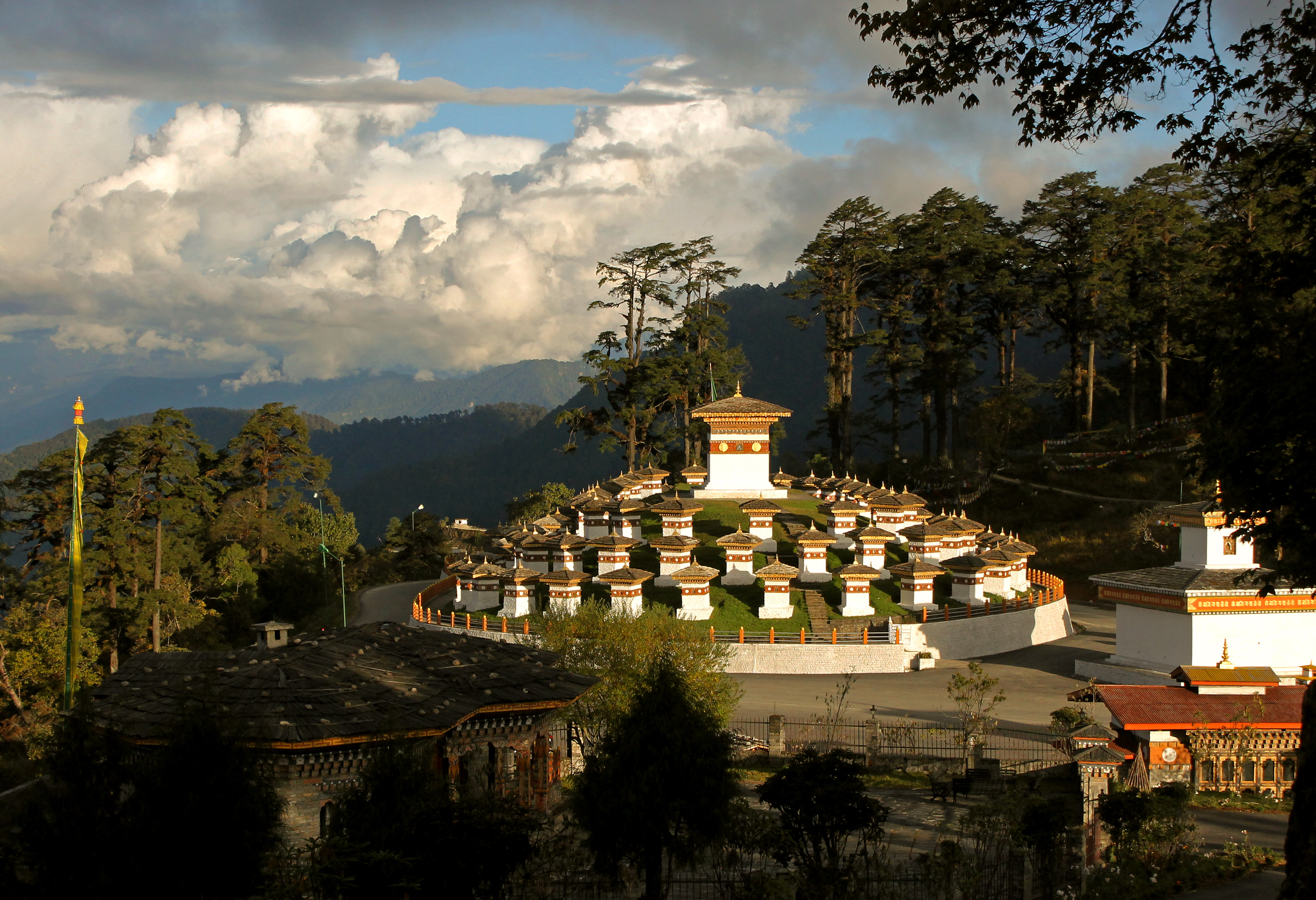
In Bhutan it seems there are beautiful old buildings everywhere. In Thimphu many of the newer buildings also display the traditional style, which goes a long way to once again preserving the history and cultural heritage.
So, those are just a few aspects of my trip to Bhutan that stood out and made we wish I’d had significantly more time to really explore further. As with many of the places I’ve visited, I plan to return one day. I’m not sure when that will be, but hopefully sooner rather than later.
Oh, and in case you’re wondering, Tashi Delek is difficult to translate directly, but it is often taken to mean “blessings and good luck” and is used in Bhutan, but also parts of Nepal and northern India.
Here is a gallery of some further photos from my trip…
Travelling – it’s all about the journey. All about the spectacular places you see, the food you eat, the fear and excitement of the unknown and the cultures and customs you experience and are often invited into. You click frantically in a desperate attempt to capture as many memories as possible, and if you’re like me, you try to keep notes and write about the unique, random and sometimes bizarre moments that will no doubt occur at regular points throughout the journey.
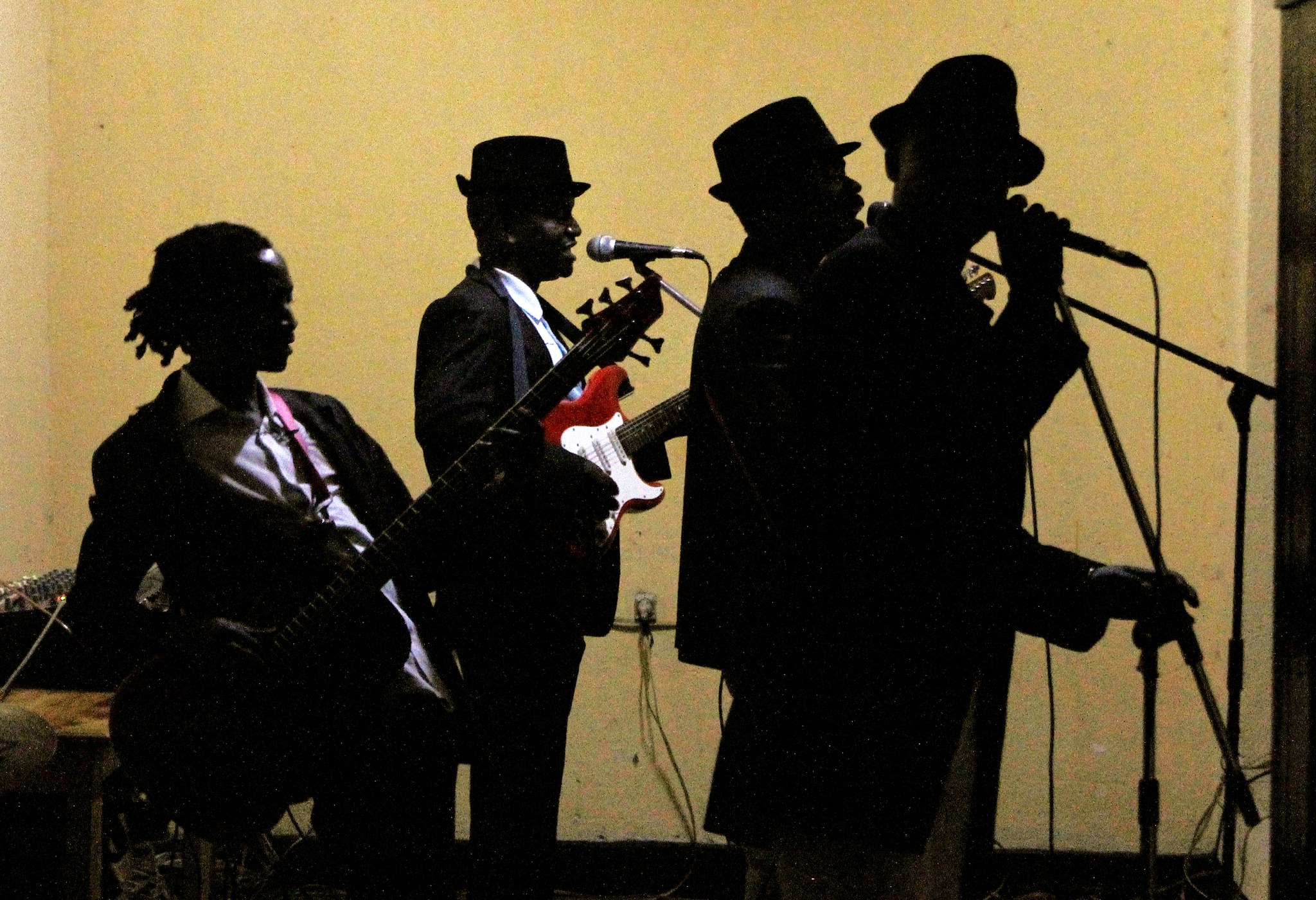
Local Rwandan band, Nyanza, Rwanda
However, during my most recent trip to Rwanda and the DRC (Democratic Republic of Congo) it dawned on me that one of the most important aspects of my travels and time abroad has been the people I’ve met, and crucially, the things I’ve learned from each and every one of these people. I have come to realize this cannot be underestimated or overlooked in regards to its value, relevance and impact.
Kim and I (halfway up a volcano)
International travelers inspire. Their sense of adventure and courage in the face of the unknown is at times baffling, but more often than not, totally energizing. They are often brave, curious, open, and unafraid to try new things, unburdened by logistics, and often equipped with a sharp and equally patient sense of humor. Those who travel live for the moment and instead of asking “Why?” the question is usually “Why not?”
Some may remark it is an irresponsible and risky existence, but I would say the outcomes of these risks are moments that will stay etched in the memory for a lifetime. From my personal experiences during my explorations I have encountered all manner of personalities, and this has undoubtedly been paramount to my own personal growth. It has inspired me to do things I had probably never before considered.
I have become more open and confident in meeting new people and more eager to strike up a conversation. My willingness to try new things has known far fewer bounds in recent years, and whilst I try my very best to be as careful and respectful as possible, I think the dive into the unknown is a truly formative experience.
At various points on my recent trip, I interacted and spent time with a group of people who truly emphasized the diversity and collective adventurous spirit of the international worker and traveler.
Firstly I reunited with three good friends who have all carved out their own individually international paths in recent years. Inga (from Norway) volunteered with me in Rwanda in 2010 and since then has gone on to spend an extended period teaching at an international school in Kigali. She has also spent time teaching in refugee camps in Lebanon (predominantly home to Syrian refugees) and is now about to begin a PhD at Oxford University researching education in refugee camps, which will once again take her to camps in East Africa and the Middle East.
Kirsty (from Canada) is a web designer and online entrepreneur currently based in Rwanda and responsible for this great website www.livinginkigali.com. She also travels extensively and a major part of this is dedicated to her work with disaster relief projects. In the past few years she has been to Haiti, Bangladesh, Malawi and most recently, Nepal as a volunteer for an organisation which sends volunteers to assist with work after major disasters (www.hands.org).
Finally Kim (from the US) is also a former fellow volunteer in Rwanda. Since our work together in 2010 she has lived in Bogota, Colombia and Dar es Salam, Tanzania and traveled a great deal during this time. It is safe to say that Kim has experienced some of the very real challenges of life in major international capital cities and has been a constant and reliable source of knowledge and advice during the past few years.
So, as you can imagine, the stories and experiences shared when we all came together were humorous, intriguing, eye-opening, but most importantly they provided a very real insight into a wide variety of life experiences and challenges.
(L-R) Johnny, me, Inga, Kirsty and Kim
We all signed up to hike Mount Nyiragongo in DRC and personally I was a little reluctant when the volcano hike was in the planning stages due to cost and risk. Eastern DRC is an area rife with extremely dangerous rebel groups that reside in the dense forests and often unleash brutal and devastating attacks on surrounding towns and villages. It is the reason why there are large numbers of UN peacekeepers based in nearby Goma.
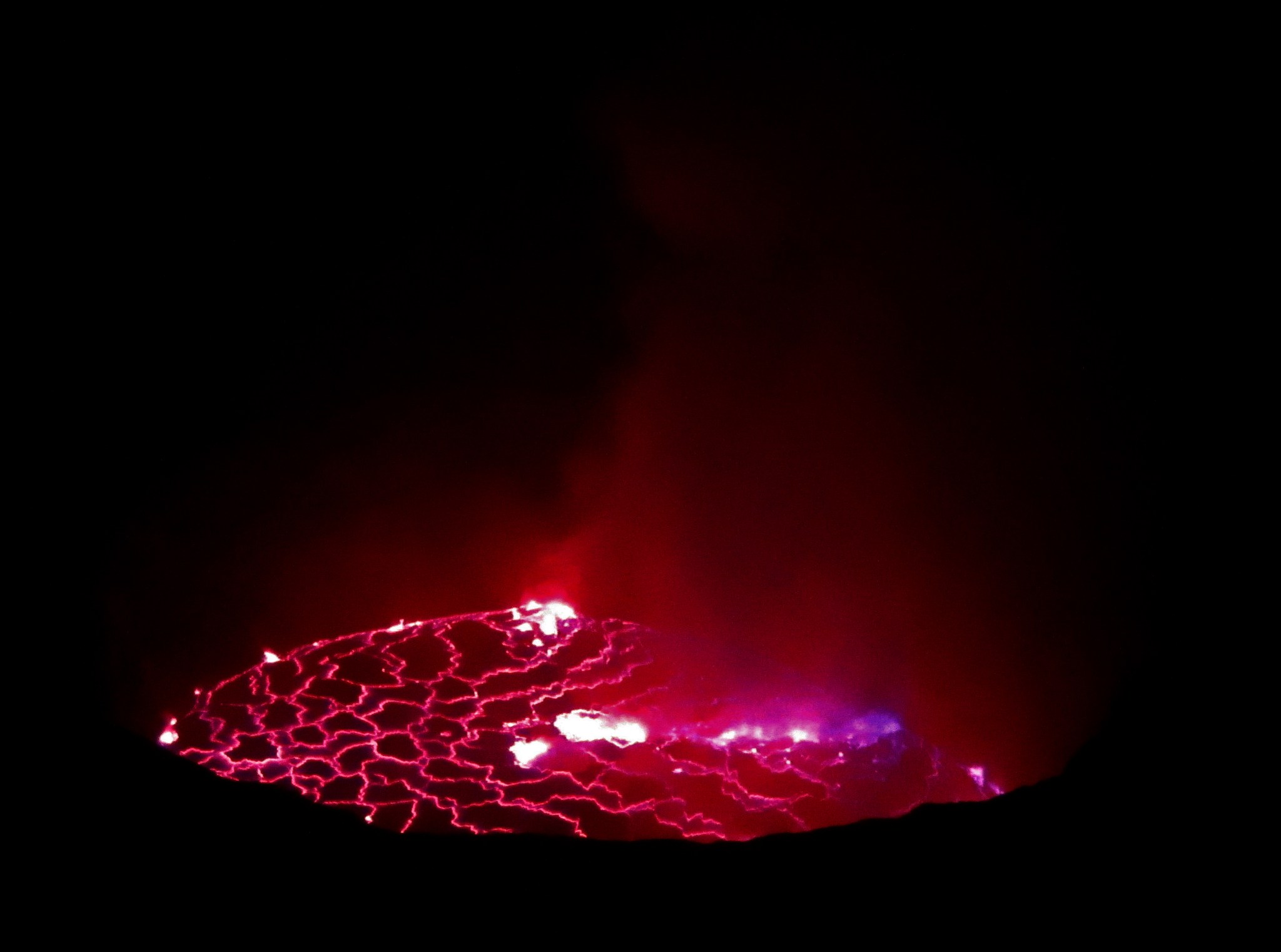
In addition to that Nyiragongo is an active volcano, which last erupted in 2002 leaving the town of Goma covered and destroyed by lava. The people are still rebuilding their homes and lives today. However, with a bit of peer pressure and that adventurous spirit, I was persuaded to sign up for the hike. Why not?!
Mount Nyiragongo
Looking into the belly of the volcanoat midnight
Freezing, but happy at the ridge of the volcano
Also in our group for the volcano climb was Johnny from Ireland. Now if you want to hear stories about international adventures, Johnny is your man. He is currently on an 8 year mission to visit every country in the world. At the time of meeting him he was up to about 145 countries.
How does he fund this you may ask? Well, a few years ago he was in a 9-5 office job which he disliked. So, he set up a travel blog/website and once this gained interest and popularity, it quickly attracted advertisers and he realized this was a liberating and exciting way to earn money.
He recently celebrated breaking the $1 million mark for income generated by his online work. This is one of his websites; http://onestep4ward.com/.
Kim, Johnny and I
The hike was tough, but chatting with Johnny and hearing his many stories from almost any country you can think of helped pass the time and keep our minds off the sometimes grueling ascent and knee-jerking descent.
At our hotel in Goma before beginning the hike we met Finbarr O’Reilly, an international correspondent and photographer, who was based in Africa when Mount Nyiragongo erupted in January 2002 and arrived on the scene the very next day. He has been visiting and working in the DRC ever since.
He has also spent time working in Afghanistan, Darfur, Niger, Somalia, Libya and many other challenging locations, which have exposed to him to some of the most emotionally challenging scenes you can imagine. This is his photography website http://www.finbarr-oreilly.com/.
We also shared a ride with Finbarr back from Goma to Kigali and in the car with us that day was Paul. Paul’s job is to work in conjunction with the US State Department organizing hip hop workshops around the world. The overarching mission of the project is to promote diplomacy, reconciliation and trauma relief among young people who have been affected by various challenges often due to war and conflict.
It was fascinating hearing about such a program and how it has achieved such positive results in a diverse set of countries to date. Paul has facilitated these all over the world and it was really very cool to hear about such novel and unique methods of providing assistance and support to young people across the world.
So, in the space of just a few short days I was able to speak with, and more importantly, draw inspiration from a fascinating collection of people. Our volcano hike group was truly international and this is what I love.
Of course, this is not solely reflected in this one specific trip. It has been the case everywhere I’ve traveled/lived, and it is one of the reasons the travel bug gets you. You never know for sure who you are going to meet, where they will be from or what their background is.
The one thing you can almost guarantee though is that whoever you cross paths with at that particular time will have a new story to tell, a new place to recommend and an ability to open your eyes to a new perspective that you may not have considered previously. And that I have found is priceless.





















































































































 UNDER ONE SUN